Concrete calculator
A 4 inch slab takes 1.23 cubic yards of concrete per 100 square feet, before waste. Multiply length × width × thickness in feet, divide by 27 for cubic yards, and add 5% for spillage and uneven ground. A 10 × 10 ft slab 4 in thick needs 1.5 yd³ ordered, or 59 bags of 80 lb.
Updated · Same math as the AreaPal app's estimates
How much concrete do I need?
1.5yd³
59bags
35ft³
$434–$773
Concrete slab installed, $4.34–$7.73 per sq ft, from LawnStarter, November 2026- Wire mesh, 5 × 10 ft sheets
- 3 sheets
- Gravel base, 4 in
- 2.5 tons
- Slab area
- 100 sq ft
Includes 5% waste. Bag yield: 0.0075 ft³ per lb of dry mix. Same math as the AreaPal app's concrete estimate.
Step 2 · the real size
Measure the real job in AreaPal
A typed rectangle is a guess. Draw the outline on the satellite map and the estimate uses the exact area, with the same math as this calculator.
Draw it on the map
Tap the corners on the satellite view, or walk the edge with GPS.
Satellite map or GPS walkGet the exact area
Square feet, acres and every edge length, as you tap.
Cut-outs taken offCount it and quote it
The estimate counts the materials; the quote prices them with your own costs.
Same math as this page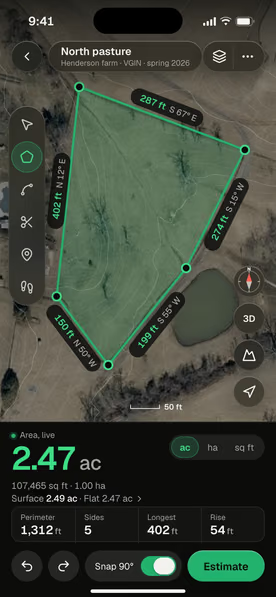

How do you figure concrete for a slab?
Cubic yards = length (ft) × width (ft) × thickness (in) ÷ 12 ÷ 27, plus 5% waste. Ready-mix is ordered in quarter yards, so round up to the next 0.25. For bags, divide the cubic feet by what one bag makes: an 80 lb bag makes 0.60 ft³, a 60 lb bag 0.45 ft³ and a 40 lb bag 0.30 ft³.
How many yards of concrete per 100 square feet?
| Thickness | Cubic yards | Cubic feet | 80 lb bags |
|---|---|---|---|
| 3 in | 0.93 | 25 | 42 |
| 4 in | 1.23 | 33.3 | 56 |
| 5 in | 1.54 | 41.7 | 70 |
| 6 in | 1.85 | 50 | 84 |
| 8 in | 2.47 | 66.7 | 112 |
Concrete job cost: what contractors charge
Ranges from public cost guides, as each one states them. They're what a contractor charges for the work, not material prices and not AreaPal's. A real quote starts with measuring the job.
| Job | Typical cost | Source |
|---|---|---|
| Concrete slab installedInstalled; average $6.60 per sq ft | $4.34–$7.73 per sq ft | LawnStarter, November 2026 |
| Concrete slabTypical slab range | $4–$8 per sq ft | This Old House, March 2026 |
| Concrete per cubic yardConcrete only; delivery not stated | $113–$126 per cubic yard | This Old House, March 2026 |
| Ready-mix concrete deliveredDelivered; $125–$133 per cu yd without delivery, plus a short-load fee of $15–$17 per cu yd on small orders | $175–$195 per cubic yard | Fixr, January 2025 |
How many bags of concrete do I need?
An 80 lb bag of concrete makes 0.60 cubic feet, a 60 lb bag 0.45 and a 40 lb bag 0.30. A cubic yard (27 cu ft) takes 45 bags of 80 lb, 60 of 60 lb or 90 of 40 lb. A 4 ft × 4 ft pad 4 in thick needs 10 bags of 80 lb, with 5% extra.
10bags
5.6ft³
0.25yd³
- Area
- 16 sq ft
Includes 5% waste. Yield 0.0075 cu ft per lb, as the AreaPal app uses.
Bags = length × width × thickness (in) ÷ 12 × 1.05 ÷ bag yield. Bag yield is 0.0075 cu ft per pound of dry mix, so 0.60 cu ft for 80 lb, 0.45 for 60 lb and 0.30 for 40 lb. Round up: you can't buy part of a bag.
| Bag | Makes | Bags per cubic yard | Bags per 10 sq ft at 4 in |
|---|---|---|---|
| 40 lb | 0.3 ft³ | 90 | 11.1 |
| 50 lb | 0.375 ft³ | 72 | 8.9 |
| 60 lb | 0.45 ft³ | 60 | 7.4 |
| 80 lb | 0.6 ft³ | 45 | 5.6 |
How much concrete for a footing?
A continuous footing 16 in wide and 8 in deep takes 0.033 cubic yards per linear foot. Multiply length × width × depth in feet and divide by 27. A 48 ft footing at 16 × 8 in is 1.6 yd³, or 72 bags of 80 lb.
- Or bags
- 72 bags
- Exact volume
- 1.58 yd³
No waste added. Same footing math as the AreaPal app's block-wall estimate.
Cubic yards = length (ft) × width (in) ÷ 12 × depth (in) ÷ 12 ÷ 27. Round up to the next 0.1 yd for ready-mix. For bags, divide the cubic feet by 0.60 for 80 lb bags.
| Footing | Cubic yards | 80 lb bags |
|---|---|---|
| 12 × 6 in | 0.185 | 9 |
| 16 × 8 in | 0.329 | 15 |
| 20 × 10 in | 0.514 | 24 |
| 24 × 12 in | 0.741 | 34 |
How much concrete for my sonotubes?
A round form holds π × radius² × height. An 8 in sonotube 4 ft deep holds 1.4 cu ft, a 10 in tube 2.18 cu ft and a 12 in tube 3.14 cu ft. With 5% extra, four 10 in tubes 4 ft deep take 16 bags of 80 lb.
- Concrete
- 9.2 ft³
- Or ready-mix
- 0.5 yd³
Includes 5% waste. Bag yield 0.0075 cu ft per lb, as the AreaPal app uses.
Cubic feet = π × (diameter in inches ÷ 24)² × height (ft) × number of tubes, plus 5%. Bags = cubic feet ÷ bag yield (0.60 cu ft per 80 lb bag). Above about a yard, ready-mix is easier.
| Diameter | Cubic feet per foot | 80 lb bags per foot |
|---|---|---|
| 6 in | 0.196 | 0.33 |
| 8 in | 0.349 | 0.58 |
| 10 in | 0.545 | 0.91 |
| 12 in | 0.785 | 1.31 |
| 16 in | 1.396 | 2.33 |
| 18 in | 1.767 | 2.95 |
| 24 in | 3.142 | 5.24 |
How much concrete for my steps?
Solid concrete steps are a stack of blocks: each step is width × run × (rise × its number). Three 4 ft wide steps with a 7 in rise and 11 in run hold 12.8 cu ft, 0.48 yd³, so 23 bags of 80 lb with 5% extra.
- Or bags
- 23 bags
- Concrete, +5%
- 13.5 ft³
Solid steps on grade, 5% waste.
Volume = Σ width × run × rise × n for n = 1 … number of steps, plus 5%. Common riser 7 in, tread 11 in. A landing at the top adds width × depth × total rise.
| Steps | Cubic feet | 80 lb bags |
|---|---|---|
| 1 | 2.2 | 6 |
| 2 | 6.7 | 18 |
| 3 | 13.5 | 36 |
| 4 | 22.5 | 60 |
| 5 | 33.7 | 90 |
How much rebar do I need?
A rebar grid puts bars both ways at a set spacing, often 12 to 18 in, with 10% added for laps. A 24 × 20 ft slab at 18 in has 31 bars, 676 linear feet, and needs 38 sticks of 20 ft.
- Bars
- 31 bars
- Linear feet
- 676 ft
Same math as the AreaPal app's slab estimate (24 × 20 ft at 18 in → 38 sticks).
Bars along the length = width ÷ spacing + 1; bars along the width = length ÷ spacing + 1. Feet = bars × their length. Sticks = feet × 1.10 ÷ 20.
| Slab | 12 in | 18 in | 24 in |
|---|---|---|---|
| 10 × 10 ft | 13 | 8 | 7 |
| 12 × 20 ft | 29 | 20 | 15 |
| 24 × 24 ft | 66 | 45 | 35 |
| 30 × 40 ft | 136 | 91 | 70 |
How much concrete mix do I need?
Premixed concrete makes 0.0075 cubic feet per pound of dry mix: an 80 lb bag 0.60 cu ft, 60 lb 0.45, 40 lb 0.30. For mixing your own, a common general-purpose ratio is 1 part cement, 2 parts sand and 3 parts gravel by volume. A 6 × 6 ft pad 4 in thick takes 21 bags of 80 lb.
- Or 60 lb bags
- 28 bags
- Or 40 lb bags
- 42 bags
- Concrete, +5%
- 12.6 ft³
- Or ready-mix
- 0.5 yd³
Includes 5% waste. Yield 0.0075 cu ft per lb, as the AreaPal app uses.
Cubic feet = length × width × thickness (in) ÷ 12 × 1.05. Bags = cubic feet ÷ bag yield. Mixing your own: about 6 bags of 94 lb Portland cement per cubic yard in a 1:2:3 mix, with sand and gravel to suit.
| Bag | Makes | Bags per cu ft | Bags per cu yd |
|---|---|---|---|
| 40 lb | 0.3 ft³ | 3.33 | 90 |
| 60 lb | 0.45 ft³ | 2.22 | 60 |
| 80 lb | 0.6 ft³ | 1.67 | 45 |
How much does my concrete weigh?
Normal concrete weighs about 4,060 lb per cubic yard, roughly 150 lb per cubic foot (2.03 short tons per yard). A 4 in slab weighs about 50 lb per square foot. A 10 × 10 ft slab 4 in thick weighs 5,012 lb.
- In short tons
- 2.51 tons
- Volume
- 1.23 yd³
- Volume
- 33.3 ft³
2.03 short tons per cubic yard, as the AreaPal app uses.
Weight (lb) = length × width × thickness (in) ÷ 12 ÷ 27 × 2.03 × 2,000. Lightweight concrete is lighter (about 110 lb per cu ft); heavily reinforced concrete is a little heavier.
| Thickness | lb per sq ft |
|---|---|
| 3 in | 38 |
| 4 in | 50 |
| 5 in | 63 |
| 6 in | 75 |
| 8 in | 100 |
| 12 in | 150 |
Work out the rest of the job
Concrete, answered
How much concrete do I need for a 10 × 10 slab?
At 4 in thick, 1.23 cubic yards, or 1.3 with 5% waste. Order 1.5 yards of ready-mix, or about 59 bags of 80 lb.
How much is a yard of concrete?
A cubic yard is 27 cubic feet: a cube 3 ft on each side. It covers 81 square feet at 4 in thick, or 54 square feet at 6 in.
How thick should a concrete slab be?
4 in is the usual thickness for patios, walks and shed floors. Driveways and slabs that carry vehicles are usually 5 to 6 in. Check your local code for anything structural.
Should I order extra concrete?
Yes. Add 5 to 10% for spillage, form bulges and a base that isn't perfectly flat. Running short mid-pour is worse than a little left over.
How many 80 lb bags of concrete make a yard?
45 bags. Each 80 lb bag makes 0.60 cubic feet and a cubic yard is 27 cubic feet.
How deep should a footing be?
Below the frost line where you live, and at least 12 in below grade. The footing itself is commonly 8 to 12 in thick and twice as wide as the wall.
How many bags of concrete for a 10 in sonotube?
About 0.91 bags of 80 lb per foot of depth, so 3.6 bags for a 4 ft tube before waste.
What is the standard rise and run for steps?
A rise of about 7 in and a tread of about 11 in is comfortable; codes commonly cap rise at 7¾ in and set a minimum 10 in tread.
What spacing for rebar in a slab?
12 to 18 in each way is common for driveways and slabs; follow the plans for anything structural.
What is the mix ratio for concrete?
1:2:3 (cement, sand, gravel by volume) is a common all-purpose mix; 1:1.5:3 is stronger. Premix bags have the ratio built in.
Sources: Bag yields from Quikrete and Sakrete product labels (an 80 lb bag of concrete mix makes about 0.60 cu ft). 27 cu ft per cubic yard by definition. 5% waste, mesh lap, base compaction and the 2.03 t per cu yd weight: AreaPal app rules.
Measure the real area first.
Then count the materials.
Draw the slab, bed, drive or fence line on the satellite map in AreaPal, and the estimate uses the same math as this calculator.
 Imagery USDA NAIP 2023
