
The short answer
- Measure the fence line in feet and subtract the gates; posts go every 6 to 8 ft.
- Posts = sections + one per straight stretch + 2 per gate. Lisa Moreno's 212 ft fence takes 30.
- Bury a third of the fence's height, at least 2 ft, in a hole about three times the post's width, set in concrete.
- Call 811 a few days before you dig, and confirm where the property line is.
How do you build a fence, step by step?
You build a fence by measuring the line, calling 811, setting the posts in concrete, then fastening the rails, the pickets or panels, and the gate. The posts are most of the work and decide whether the fence stays straight, so most of this guide is about them.
| Stage | What you do | Rule of thumb |
|---|---|---|
| Measure | Stake the line, measure each run, subtract gates | Feet to build = runs − gate openings |
| Call 811 | Have buried lines marked | A few business days before digging |
| Posts | Dig, set in concrete, plumb and brace | Every 6–8 ft, a third of the height deep, at least 2 ft |
| Rails | Fasten between or across the posts | 2 per section up to 4 ft high, 3 for 5–6 ft |
| Pickets | Fasten to the rails | Feet × 12 ÷ picket width, plus about 5% |
| Gate | Hang on the heavier hinge post | 4 ft for a walk gate |
How do you measure for a fence?
You measure for a fence by staking every corner, end and gate of the planned line, measuring each straight run between the stakes in feet, and adding the runs. Then take the gate openings off to get the feet of fence you will actually build.
Settle where the line goes first. The plat or survey shows the property line and the corner pins, and most fences sit a few inches inside it so the whole fence is on your land. Mark the gates now as well, since they change the post count. Measure along the ground, not level: on a slope the fence follows the ground.
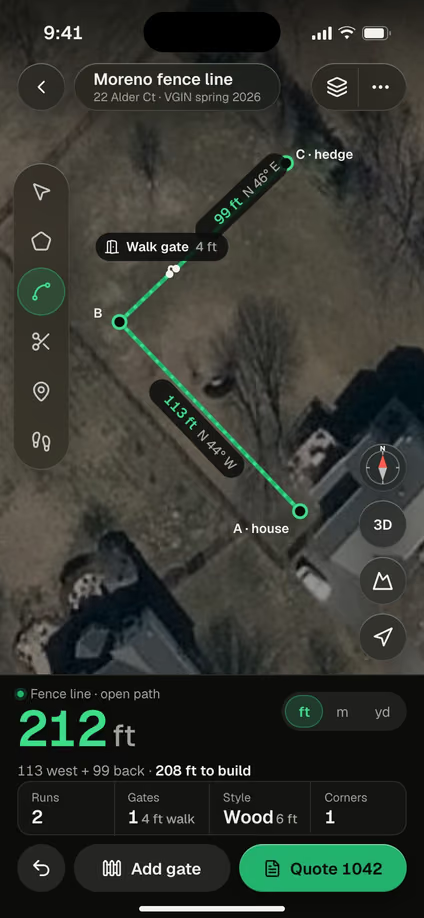
Lisa Moreno’s backyard in Warrenton is a simple L: 113 ft along the back, then 99 ft up the side, 212 ft (64.6 m) in all. One 4 ft walk gate leaves 208 ft to build.
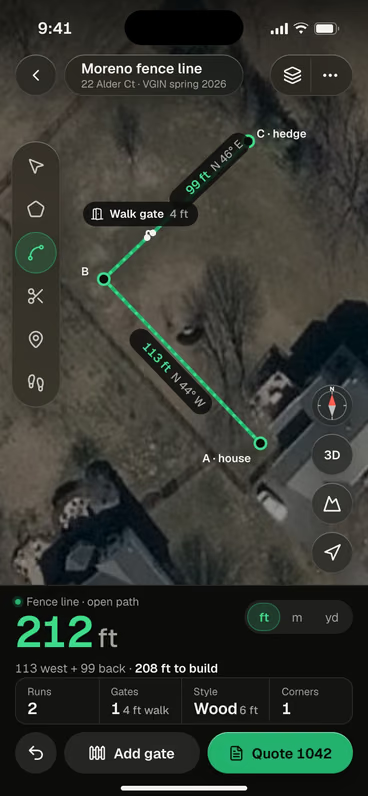
The line is drawn on the satellite map along the yard’s edges, with the gate placed on it. The length reads as you draw, before anyone stakes it out.
You can draw the line on a satellite map before you stake it, then confirm it with a tape or a measuring wheel. Where trees hide the edge, walk it with your phone’s GPS.
How many fence posts do you need?
You need one post per section, plus one to finish each straight stretch of fence, plus two gate posts for every gate. Sections are the feet to build divided by the post spacing, rounded up. For a single straight line with no gate, that is the length ÷ spacing + 1.
Posts usually go every 6 to 8 ft; 8 ft is common for wood, where 2×4 rails are usually sold in 8 ft lengths. At 8 ft, Lisa’s 208 ft is 208 ÷ 8 = 26 sections. The gate breaks her line into two stretches, so 26 + 2 = 28 line posts, and the gate adds 2 heavier gate posts: 30 in all. A corner post ends one run and starts the next, so it is counted once.
| Item | Working | Count |
|---|---|---|
| Fence to build | 212 ft − 4 ft gate | 208 ft |
| Sections | 208 ÷ 8 | 26 |
| Line posts, 4×4 | 26 sections + 2 stretches | 28 |
| Gate posts, 6×6 | 2 per gate | 2 |
| Posts in all | 28 + 2 | 30 |
When a run does not divide evenly by the spacing, round the sections up and space that run’s posts a little closer, so every section on it is the same width. The fence calculator does this count for any length and gate.
Do you need to call 811 before installing fence posts?
Yes, you need to call 811 before installing fence posts, because every post hole is a dig and gas, power and fiber lines often run along property lines. Call 811 or file the request online a few business days ahead; the utilities mark their lines with paint or flags. Dig by hand near the marks.
Check the rules at the same time: many towns want a permit for a new fence and limit its height, especially in a front yard, and HOAs often set the style. A fence on a disputed line is a job for a licensed surveyor first.
How do you install a fence post?
You install a fence post by digging a hole about three times the post’s width and deep enough to bury a third of the fence’s height, at least 2 ft, then setting the post plumb in concrete. Set the corner, end and gate posts first, run a string between them, and line the other posts up to it.
- Dig the hole. About 10 in wide for a 4×4, which is 3.5 in square. Go below the frost line where the ground freezes; your building department gives the depth.
- Add gravel. Put a few inches of gravel in the bottom so water drains away from the end of the post.
- Set and plumb the post. Stand it in the hole, check it with a level on two faces and brace it with stakes.
- Fill with concrete. Follow the bag’s directions, fill to just below the ground and slope the top away from the post so water runs off.
- Let it set. Fast-setting mix sets in 20 to 40 minutes; wait about 4 hours before rails, panels or a gate go on (Quikrete).
| Fence height | Minimum: ⅓ of the height, at least 2 ft | Deeper rule: ⅓ of the post's length |
|---|---|---|
| 4 ft | 2 ft deep, 6 ft post | 2 ft deep, 6 ft post |
| 6 ft | 2 ft deep, 8 ft post | 3 ft deep, 9 ft post |
| 8 ft | 2 ft 8 in deep, 10 ft 8 in post | 4 ft deep, 12 ft post |
The deeper rule, about a third of the post’s length in the ground, works out to half the fence’s height. Use it in loose or sandy soil, for tall fences and for gate posts, which carry the weight of a swinging gate. The fence post depth calculator works it out for your fence.
How much concrete do you need per fence post?
You need about 2 bags of 50 lb fast-setting concrete for a 4×4 post in an 8 in hole 2 ft deep, and more as the hole gets wider or deeper. A 50 lb bag yields about 0.375 cu ft; the concrete is the hole’s volume minus the post.
| Post | Hole, width × depth | Concrete | 50 lb bags |
|---|---|---|---|
| 4×4 | 8 in × 24 in | 0.53 cu ft | 2 |
| 4×4 | 10 in × 24 in | 0.92 cu ft | 3 |
| 4×4 | 12 in × 24 in | 1.40 cu ft | 4 |
| 6×6 gate post | 10 in × 36 in | 1.01 cu ft | 3 |
| 6×6 gate post | 12 in × 36 in | 1.73 cu ft | 5 |
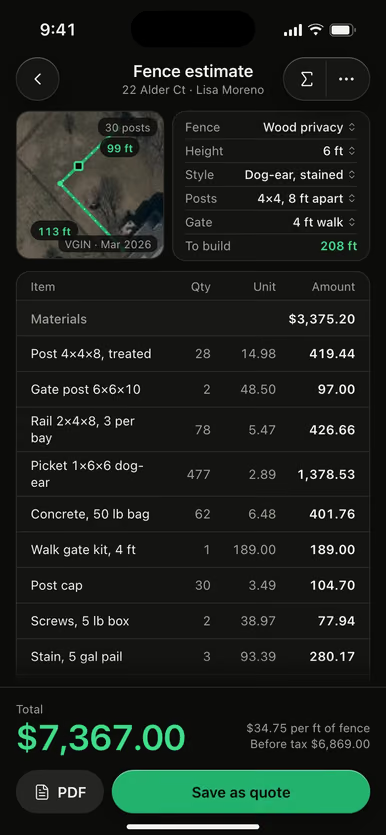
Lisa’s estimate uses 2 bags for each line post and 3 for each gate post: 28 × 2 + 2 × 3 = 62 bags. That is an 8 in hole for the line posts; at 10 in wide, the three-times-the-post rule, each line post takes 3 bags and the fence about 90. For the full yardage on a long fence, use the fence post concrete calculator.
How do you attach the rails and pickets?
You attach the rails level from post to post, two per section up to 4 ft high and three for a 5 to 6 ft fence, then fasten the pickets to the rails. Use exterior-rated screws or galvanized nails so they don’t rust through.
| Fence height | Rails per section | Lisa's 26 sections |
|---|---|---|
| Up to 4 ft | 2 | 52 |
| 5–6 ft | 3 | 78 |
| 8 ft | 3–4 | 78–104 |
For pickets edge to edge, the count is the feet to build × 12 ÷ the picket’s real width, plus about 5% for waste. A 1×6 picket is 5.5 in wide, so Lisa’s 208 ft is 208 × 12 ÷ 5.5 = 453.8 pickets; with 5% it is 476.5, so 477. Check every few pickets with a level, since a small lean grows along the fence, and keep the bottoms a couple of inches off the ground so they stay dry.
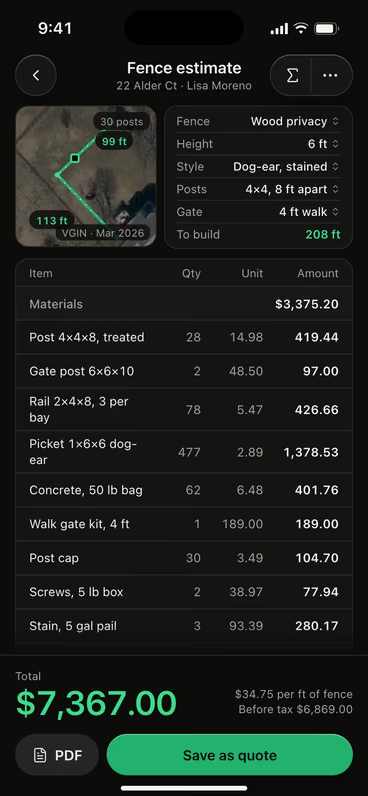
Lisa Moreno’s estimate: 28 line posts and 2 gate posts, 78 rails, 477 pickets, 62 bags of 50 lb concrete and a walk gate kit, from the line drawn on the map.
How do you hang a fence gate?
You hang a fence gate on a heavier post set deeper than the line posts, with a diagonal brace in the gate frame that runs from the bottom of the hinge side up to the top of the latch side. Build or buy the gate a little narrower than the opening so it swings freely, hang it on the hinges, then fit the latch.
A walk gate is usually 4 ft, wide enough for a mower; a double drive gate is 10 to 12 ft. Measure the opening between the gate posts once they are set, not before.
 Draw the fence line, get the postsAreaPal counts posts, rails, pickets and concrete from the line, then builds the quote.

Should you build a fence yourself or hire a contractor?
Building a fence yourself saves the labor but not the materials, and a contractor typically charges $15 to $35 per linear foot installed for wood (Fixr, 2025; This Old House, 2026). That is what a contractor charges the customer, not AreaPal’s price.
| Job | Typical cost | Source |
|---|---|---|
| wood fence installedInstalled. A general wood range, any style | $15–$35 per linear foot | This Old House, June 2026; Fixr, January 2025 |
| wood privacy fence installedInstalled, materials and labor | $15–$45 per linear foot | Fixr, January 2025 |
What a contractor charges the customer. US, read November 2026. Not AreaPal's price.
For every material and a worked 200 ft example, see how much a fence costs. Fence installers can see how AreaPal measures, counts and quotes a fence on the fence contractors page.
Questions
How do you install a vinyl fence post?
Dig and set it in concrete like a wood post, at the depth the fence maker gives. Slide the rails into the post's routed holes as you go, since a set vinyl post can't be moved to fit them, and add the maker's aluminum stiffener to gate posts where it calls for one.
How do you install chain link fence posts?
Set the terminal posts (ends, corners and gate posts) in concrete first, run a string between them, then set the line posts no more than 10 ft apart. Hang the fabric only after the concrete has set.
How long before you can attach rails to a fence post set in concrete?
Fast-setting post mix sets in 20 to 40 minutes, and Quikrete says to wait about 4 hours before putting heavy force on the post, such as rails, panels or a gate. Regular concrete needs a day or more; follow the bag.
Can you set fence posts without concrete?
Yes. Posts can be set in tamped gravel or tamped soil, which drains well and makes a post easier to replace. Concrete holds better in soft ground and for gate posts, which carry the most load.
How do you build a fence on a slope?
Either rack the fence, so the rails and pickets follow the ground, or step it, so each section is level and drops at the post. Measure the line along the ground, since that is the length of fence you build.
Sources: Call 811 before digging: Common Ground Alliance. Lumber sizes (a 4×4 is 3.5 in square, a 6×6 is 5.5 in, a 1×6 picket is 5.5 in wide): American Softwood Lumber Standard, PS 20. Bag yield (50 lb about 0.375 cu ft), set time and the 4 hour wait: Quikrete Fast-Setting Concrete Mix directions. Chain link line posts at most 10 ft apart: ASTM F567, Standard Practice for Installation of Chain-Link Fence. Post spacing, burial depth and hole width are common fence-building practice; your local building department sets the frost depth. Typical installed costs, what a contractor charges the customer: Fixr, Fence Installation Cost and Privacy Fence Cost (January 31, 2025); This Old House, fencing options cost guide (June 8, 2026). Lisa Moreno's fence is AreaPal's example job.
 Imagery USDA NAIP 2023
