
The short answer
- Patios, walks and shed floors: 4 in thick. Driveways: 4 in for cars, 5–6 in for trucks and RVs.
- Pour on a compacted gravel base about 4 in deep, inside forms staked level with a slight fall for drainage.
- Concrete in cubic yards = length × width × thickness in feet ÷ 27. One cubic yard covers 81 sq ft at 4 in.
- An 80 lb bag makes about 0.6 cu ft, so a cubic yard is 45 bags. Above about a yard, order ready-mix.
How thick should a concrete slab be?
A concrete slab should be 4 in thick for patios, walks, shed floors and car driveways, and 5–6 in where trucks, RVs or heavy equipment will sit on it. Four inches is the thickness the residential code, the cement industry and ready-mix plants all work from.
| Slab | Typical thickness | When to go thicker |
|---|---|---|
| Patio | 4 in | Hot tub or outdoor kitchen: 5–6 in |
| Walkway, sidewalk | 4 in | Where a car crosses it: 5–6 in |
| Shed floor | 4 in | Riding mowers or a workshop: 5 in |
| Driveway, cars | 4 in | Pickups, RVs, delivery trucks: 5–6 in |
| Garage floor | 4 in | Heavy trucks or a vehicle lift: 5–6 in |
| House slab on ground | 3.5 in minimum, 4 in usual | Engineered loads per the plans |
| Footing | 6 in minimum, 12 in wide | Larger houses, poor soil: 8–12 in |
A house slab is at least 3.5 in under the International Residential Code, and most builders pour 4 in; footings or a thickened edge under the bearing walls carry the house, sized in the plans. A concrete footing is at least 6 in thick and 12 in wide under the same code and must sit below the local frost line. For a driveway, the Portland Cement Association’s guidance is 4 in for passenger cars and 5 in or more for heavier vehicles. Where something heavy sits in one spot, such as a hot tub, thicken that part rather than the whole slab.
A firm, even base and control joints at the right spacing do more against cracking than an extra inch of concrete on soft ground.
How do you prepare the base and build forms for a slab?
You prepare the base by digging out the soil to the slab thickness plus about 4 in and compacting gravel in that space, then you build forms of boards staked on edge around it. For a 4 in slab on 4 in of gravel, dig about 8 in down.
- Mark and check. Stake and string the outline, square it by measuring both diagonals until they match, and call 811 a few days before you dig so buried lines are marked. Check whether your town needs a permit.
- Dig. Remove sod, roots and soft soil. Compact the bottom with a plate compactor or hand tamper.
- Lay the base. Spread crushed gravel in 2 in layers and compact each one until the base is firm and you can walk on it without leaving prints. Wet it lightly so it compacts well. A gravel calculator works out the gravel for the area and depth.
- Build the forms. Set boards on edge along the string lines with their tops at the finished height. A 2×4 is only 3½ in tall, so use 2×6s for a full 4 in slab, or set 2×4s on a base that is level with their bottom edge. Drive stakes every 3–4 ft on the outside and screw them to the boards.
- Set the fall. Slope the form tops about ⅛–¼ in per foot away from the house so water runs off. Over 10 ft, ¼ in per foot is a 2½ in drop.
How much concrete do you need for a slab?
You need the slab’s length × width × thickness, all in feet, divided by 27 to get cubic yards. Thickness in feet is the inches divided by 12, so 4 in is 0.333 ft. A 10 × 10 ft slab 4 in thick is 10 × 10 × 0.333 ÷ 27 = 1.23 cu yd. Add 5–10% for uneven ground and spills.
| Thickness | Cubic yards | 80 lb bags | 60 lb bags |
|---|---|---|---|
| 4 in | 1.23 | 56 | 75 |
| 5 in | 1.54 | 70 | 93 |
| 6 in | 1.85 | 84 | 112 |
One cubic yard is 27 cu ft, which covers 81 sq ft at 4 in, 65 sq ft at 5 in and 54 sq ft at 6 in. In bags, an 80 lb bag of premixed concrete makes about 0.6 cu ft, so a cubic yard takes 45 bags of 80 lb, 60 bags of 60 lb or 90 bags of 40 lb. The bag counts in the table are before any extra.
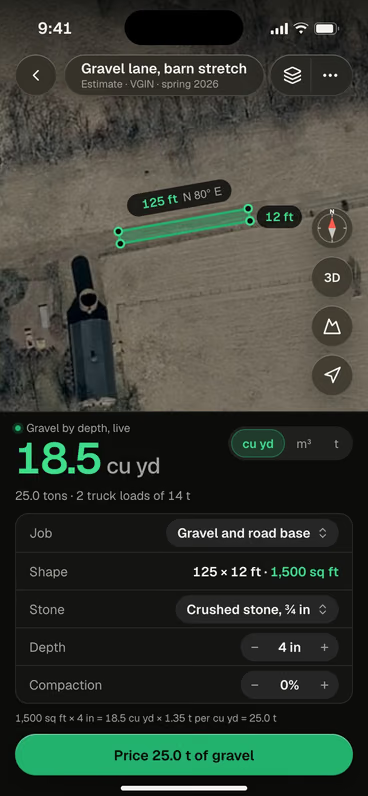
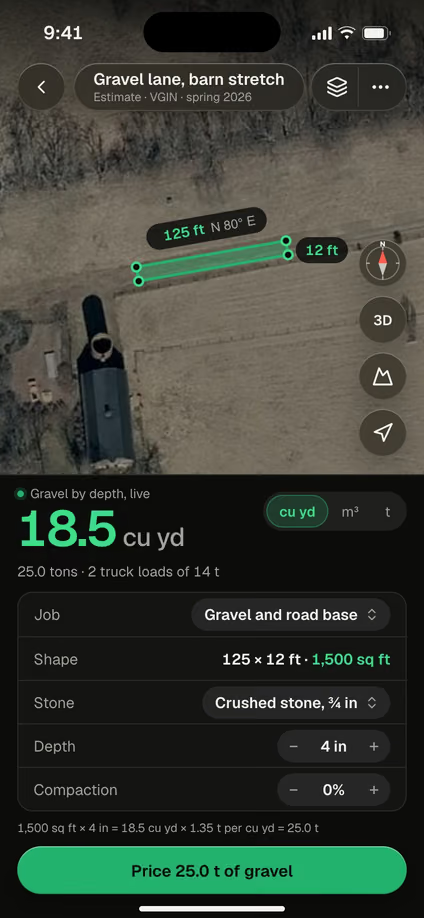
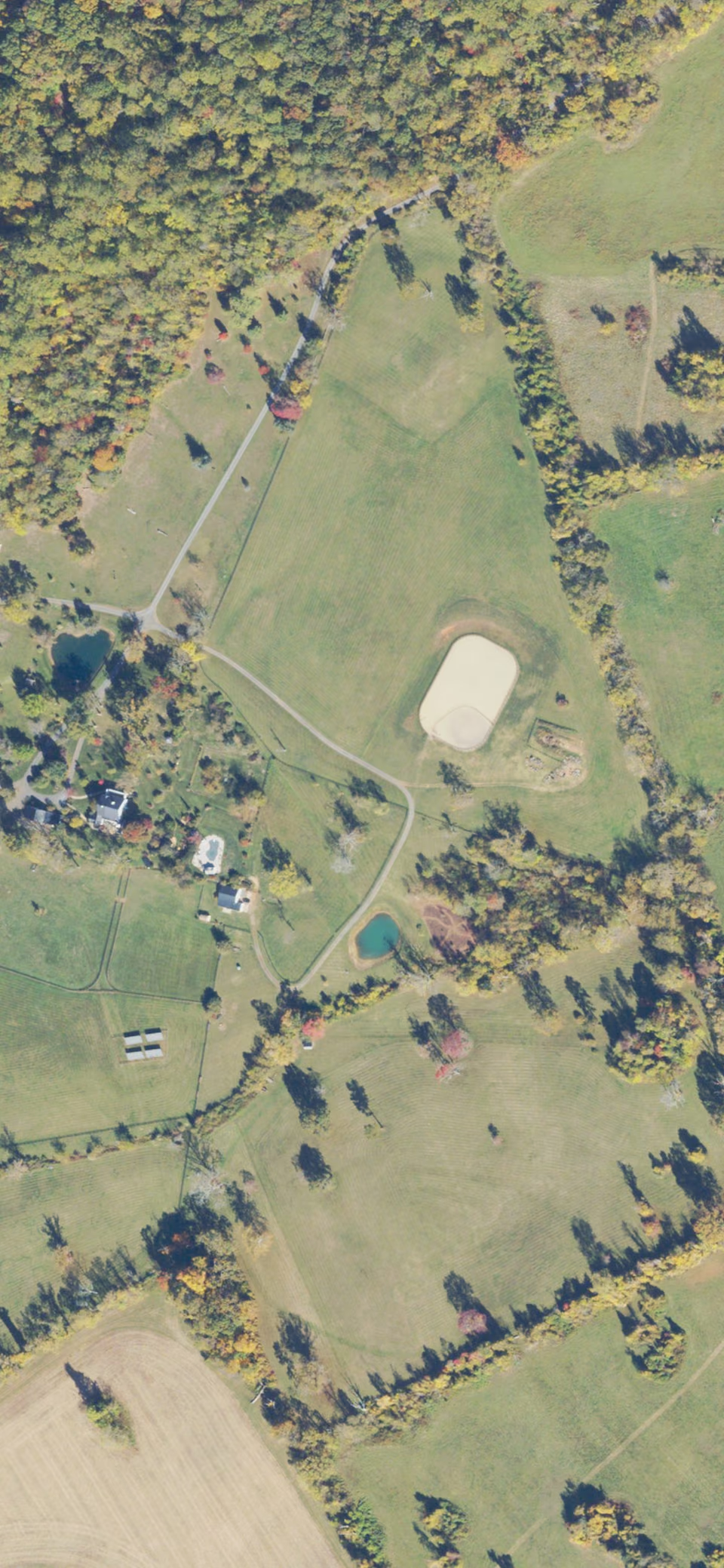
Draw the shape on the map and set the depth; the volume updates as you change it. This gravel lane, 125 × 12 ft at 4 in, comes to 18.5 cu yd, and a concrete slab estimate uses the same control.
For any size, the concrete calculator does the yards and bags. To get the area right on an odd-shaped slab, split it into rectangles first, as in how to calculate square feet.
 Measure the slab before you orderDraw it in AreaPal, set the thickness and get cubic yards and bags with your waste.

Should you use bags or ready-mix concrete?
You should use bags for small slabs up to about 1 cubic yard and order ready-mix from a truck for anything larger. Mixing 45 bags by hand or in a small mixer is a long day, and concrete poured in batches that have started to set leaves weak cold joints.
A 30 × 30 ft slab shows why. At 4 in it is 900 sq ft × 0.333 ft ÷ 27 = 11.1 cu yd, or about 12.2 cu yd with 10% extra; at 6 in it is 16.7 cu yd before extra. That is about 500 bags of 80 lb, so it is a truck job. Plan a crew of three or four, a clear path for the truck or a concrete pump, and an intermediate form board or a screed rail to strike the slab off in sections. Ask the plant for its minimum order and any short-load fee; for typical prices, see how much concrete costs.
Order 3,000–4,000 psi concrete for most slabs. Where winters freeze, ask for air-entrained concrete for anything outdoors; the tiny air bubbles help it survive freeze and thaw.
Does a concrete slab need rebar or wire mesh?
A concrete slab doesn’t strictly need rebar or wire mesh, but most outdoor slabs get one of them, because reinforcement holds cracks tight and keeps the pieces level. Thickness carries the load; steel controls cracking. Both go up for heavy vehicles.
- Wire mesh (welded wire reinforcement), commonly 6 × 6 in squares, suits patios, walks and shed floors.
- Rebar, #3 or #4 bars on a grid 18–24 in apart, suits driveways and slabs that carry vehicles or heavy loads.
- Fibers mixed into the concrete reduce small shrinkage cracks but don’t replace steel where loads are heavy.
Steel only works near the middle of the slab. Set mesh or rebar on chairs or concrete blocks so it sits about halfway up, and keep it 2–3 in back from the forms. Steel lying on the gravel does almost nothing.
Plan the control joints too. The Portland Cement Association’s rule is a spacing of 24–36 times the slab thickness, so 8–12 ft apart for a 4 in slab, in panels as close to square as you can get them.
How do you pour and finish a concrete slab?
You pour a concrete slab by filling the forms in one go, striking it level with a straight board and floating, edging and jointing the surface as it firms up. Wet the base lightly first so the gravel doesn’t pull water out of the concrete.
- Place it. Start at the far corner and fill to just above the forms. Work the concrete into corners and along the edges with a shovel, and pull the mesh up into the middle as you go.
- Screed it. Drag a straight 2×4 across the form tops with a sawing motion to strike it level, filling low spots as you go.
- Bull float it. Push a bull float across the surface right away to push down stones and smooth ridges.
- Wait for the bleed water. Water rises to the top. Don’t work it in; wait until the sheen is gone and a thumb press leaves a mark about ¼ in deep.
- Edge and joint. Run an edging tool along the forms, and cut control joints a quarter of the slab’s depth, 1 in on a 4 in slab, with a groover or later with a saw within the first day.
- Finish it. Float again with a hand float, then drag a broom across for a non-slip finish outdoors, or steel trowel it smooth for a garage or shed floor.
Don’t pour onto frozen ground or when frost is forecast in the first few days, and in hot weather pour early in the morning.
How long does a concrete slab take to cure?
A concrete slab takes about 28 days to reach its design strength, and it needs to stay moist for at least the first 7 days. Concrete hardens by a chemical reaction with water, not by drying, so a slab that dries out early ends up weaker and more likely to crack.
| After | What you can do |
|---|---|
| 1–2 days | Strip the forms and walk on it |
| 7 days | Drive cars on it; stop moist curing |
| 28 days | Full design strength; heavy trucks and RVs |
Keep it moist by misting it a few times a day, covering it with plastic sheeting or wet burlap, or spraying a curing compound right after finishing. In cold weather cover it with insulated blankets; in hot weather shade it and keep it wet. Seal an outdoor slab, if you want to, after it has cured.
Questions
Can you pour concrete directly on dirt?
You can, but the slab is more likely to crack and settle. A compacted gravel base about 4 in deep gives even support and drainage, and soft or organic soil should be dug out first.
Is 3 inches thick enough for a concrete slab?
Not for most slabs. Three inches cracks easily under point loads and leaves almost no room to center mesh or rebar. Keep it for light garden paths at most and pour 4 in for anything you walk, park or build on.
Can you pour new concrete on an existing concrete slab?
Yes, if the old slab is sound and clean. A new layer of concrete should be at least 2 in thick and bonded with a bonding agent; for thinner layers use a concrete resurfacer made for the job.
How thick should a concrete slab be for a hot tub?
A reinforced slab of 4 in on a compacted base is the usual minimum for a filled hot tub, and many makers ask for 5–6 in. Follow the tub maker's installation guide, which states the load and the pad it needs.
Sources: Minimum slab-on-ground thickness 3.5 in: International Residential Code R506.1, which follows ACI 332 (Code Requirements for Residential Concrete). Footings at least 6 in thick and 12 in wide: IRC R403.1. Driveway thickness, base, control joint spacing (24–36 times the slab thickness) and joint depth: Portland Cement Association guidance on residential concrete. Moist curing at least 7 days: ACI 308, Guide to External Curing of Concrete. Bag yield (80 lb about 0.6 cu ft, 60 lb about 0.45 cu ft, 40 lb about 0.3 cu ft): Quikrete and Sakrete product data. 811 call-before-you-dig: Common Ground Alliance. 1 cu yd = 27 cu ft: NIST Handbook 44, Appendix C.
 Imagery USDA NAIP 2023
