
The short answer
- An easement is a right to use part of someone else's land for a set purpose; it is not ownership.
- Common types are utility, access or right of way, prescriptive (by long use) and conservation easements.
- Easements are usually recorded with the deed and show on the survey, the plat or the title report.
- An appurtenant easement runs with the land, so it stays in place when the property is sold.
What does an easement mean in real estate?
In real estate, an easement means one party holds a right to use part of a property that someone else owns, for a purpose written in the easement. The owner of the land keeps title and still pays the taxes, but cannot interfere with that use. The land that carries the easement is called the servient estate. When the easement benefits a neighboring parcel, that parcel is the dominant estate.
Most easements are affirmative: they let someone do something, like cross the land or run a pipe under it. A few are negative: they stop the owner from doing something, such as building above a set height that would block a neighbor’s view or light.
What are the main types of easements?
The main types of easements are utility easements, access easements (rights of way), prescriptive easements and conservation easements. Easements by necessity and implied easements are less common and usually come out of how a parcel was split.
| Type | What it allows | How it is created |
|---|---|---|
| Utility | Power, water, sewer, gas or cable lines over or under the land | Granted to the utility, often shown on the subdivision plat |
| Access or right of way | Passing across the land to reach another parcel or a road | Written grant in a deed, or a shared driveway agreement |
| Prescriptive | A use that went on openly for years without permission | Long use, for a period set by state law |
| Conservation | Limits on building or clearing to protect the land | Voluntary agreement with a land trust or agency |
| By necessity | Access to a parcel that would otherwise be landlocked | Created by law when a parcel is split with no road access |
| Drainage | Water flowing across or a ditch or pipe running through the land | Usually shown on the plat with the utility easements |
What is the difference between an appurtenant easement and an easement in gross?
An appurtenant easement benefits a piece of land, while an easement in gross benefits a person or a company. A shared driveway that serves the lot behind yours is appurtenant: it runs with the land, so it passes to each new owner of both lots. A utility’s right to run a power line across your yard is an easement in gross: it belongs to the utility, not to a neighboring parcel.
How do you find easements on your property?
You find easements on your property in the deed, the title report, the recorded plat and the survey, all of which trace back to the county recorder. Check them in this order:
- Your deed. It may grant or reserve an easement, or say the land is sold “subject to” easements of record.
- The title report or title policy from your purchase. Recorded easements are listed as exceptions to coverage, often in Schedule B, with the book and page where each is recorded.
- The recorded plat of your subdivision. Utility and drainage easements are often drawn as strips along the lot lines, with their width.
- Your survey, if you have one. A boundary survey shows recorded easements and anything visible on the ground, such as a path or overhead line.
- The county recorder (also called register of deeds or county clerk). Search the grantor and grantee index under your name and earlier owners’ names for easement documents.
Before you dig, also call 811. That service marks buried utility lines, which is about safety, not about who holds an easement. For where the lines of your lot run in the first place, see how to find property lines.
How does an easement affect building, fences and landscaping?
An easement limits what you can build or plant inside its strip, because the holder must be able to use and reach it. Sheds, pools and permanent structures are usually not allowed on a utility or drainage easement. A fence or garden may be allowed, but the holder can often remove it to do work, without paying to replace it.
Before you build, read the easement’s recorded wording and ask your local permit office. Many towns also set setbacks from lot lines that apply on top of any easement. If you are buying a lot to build on, check the easements before you sign: a wide utility or drainage strip across the back of a small lot can leave less room for a house, a pool or a garage than the lot size suggests.
How does a prescriptive easement work?
A prescriptive easement is created when someone uses another person’s land openly, continuously and without permission for a period set by state law, typically between 5 and 21 years. A neighbor who has driven across a corner of your field to reach a road for that whole period may gain a right to keep doing it. Unlike adverse possession, it gives a right to use the land, not ownership of it.
Granting written permission usually stops a use from becoming prescriptive, because the use is no longer without permission. The rules differ by state, so an attorney is the right person to ask.
Can an easement be removed?
An easement can end in a few ways: the holder signs a written release, the same person comes to own both parcels, the purpose ends, or a court finds it abandoned. An easement with a set term ends on its date. Removing one usually needs the holder’s agreement and a document recorded with the county, so a real estate attorney or title company should handle it.
How can you plan around an easement on your lot?
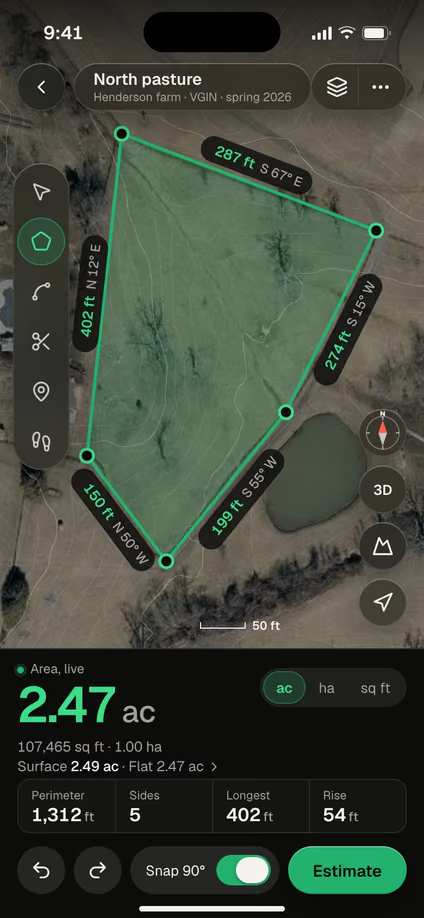
You plan around an easement by marking where it runs on a sketch of your lot before you place a fence, shed or garden. Take the easement’s width and position from the plat or survey, then draw the lot and the easement strip so you can see how much usable yard is left.
AreaPal doesn’t show property lines or parcel data. It measures what you trace on the satellite map or walk with GPS (see how to measure land), so the sketch is only as good as the plat measurements you copy into it. It is an estimate for planning, not a legal boundary or a legal location of the easement. For that, use the recorded plat and a licensed surveyor. To read the deed’s description itself, see legal descriptions of property.
 Plan the yard around itOutline your lot in AreaPal, cut out the easement strip and see the area that is left for a fence or garden.

Questions
Who maintains an easement?
Usually the party that uses the easement maintains what it built there, such as the utility for its lines or the neighbor for a shared driveway. The recorded easement document can set different terms, so read it first.
Is a right of way the same as an easement?
A right of way is one kind of easement, the right to pass across someone else's land on foot or by vehicle. Easements also cover other uses, such as utilities, drainage or conservation.
Do easements show on a property survey?
Recorded easements usually show on a boundary survey and the recorded plat as strips with their width and purpose. An unrecorded easement, such as a prescriptive one, may not appear on any document.
Does an easement end when the property is sold?
An appurtenant easement does not end with a sale; it passes to the new owner along with the land. Some easements in gross can be transferred too, and a few end on a set date or event written in the document.
Sources: Cornell Law School, Legal Information Institute (Wex): easement, easement appurtenant, easement in gross, prescriptive easement; prescriptive periods are set by each state's law. Explainer only, not legal advice: for a specific property, ask a real estate attorney or a title company.

 Imagery USDA NAIP 2023
