
The short answer
- Build it in three layers, about 8 to 12 in in all: coarse stone, then #57 stone, then crusher run on top.
- Cubic yards = length × width × depth in feet ÷ 27. One cubic yard covers about 108 sq ft at 3 in.
- Tons ≈ cubic yards × 1.4 for most crushed stone, an assumption; check your supplier's weight.
- Crown the middle and edge the sides so water runs off and the gravel stays put.
How do you build a gravel driveway?
You build a gravel driveway by digging out the soil to firm ground, laying fabric, and building crushed stone in three compacted layers, coarse at the bottom and fine on top, with a crown so water runs off. Each layer does a job: the coarse stone carries the load, the middle layer locks it, and the top packs into a surface you can drive on.
| Layer | Stone | Depth | Job |
|---|---|---|---|
| Fabric | Woven geotextile | — | Keeps stone and soil apart |
| Base | #3 stone, about 1 to 2 in | 4–6 in | Carries the load and drains |
| Middle | #57 stone, 1 in and down | 3–4 in | Fills and locks the base |
| Top | Crusher run (crushed stone with fines) | 2–4 in | Packs into a firm surface |
| In all | About 8–12 in |
Stone names change by region and quarry: crusher run is also sold as dense grade, road base or #411. Ask the supplier for the stone they sell for each layer.
How deep should a gravel driveway be?
A gravel driveway should be about 8 to 12 in of compacted stone in all, deeper on soft clay and where heavy trucks will use it. A drive for cars on firm, well-drained ground can sit at the shallow end; a farm lane for loaded trucks belongs at the deep end, or deeper.
Crown the drive too: the middle sits higher than the edges, about ½ in per foot (4%), so rain runs off to the sides instead of pooling in the tire tracks. A 12 ft wide drive is about 3 in higher in the middle than at each edge.
How much gravel do you need for a driveway?
You need the driveway’s length × width × depth in feet ÷ 27 cubic yards of gravel for each layer, and about 1.4 tons for every cubic yard. One cubic yard covers about 162 sq ft at 2 in deep, 108 sq ft at 3 in and 81 sq ft at 4 in.
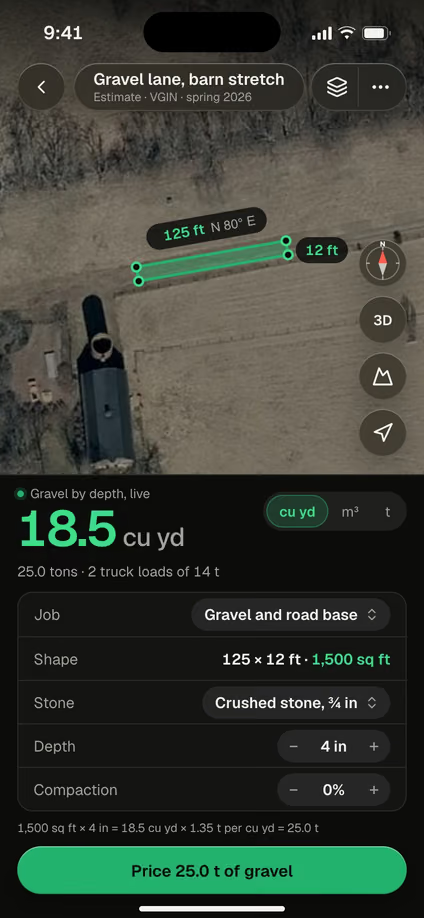
Here is a 125 × 12 ft lane, 1,500 sq ft, with 4 in of base, 4 in of #57 and 3 in on top:
| Layer | Calculation | Cubic yards | Tons, at 1.4 |
|---|---|---|---|
| Base, 4 in | 1,500 × 4 ÷ 12 ÷ 27 | 18.5 | 25.9 |
| Middle, 4 in | 1,500 × 4 ÷ 12 ÷ 27 | 18.5 | 25.9 |
| Top, 3 in | 1,500 × 3 ÷ 12 ÷ 27 | 13.9 | 19.4 |
| In all, 11 in | 50.9 | 71.3 |
Compaction settles each layer, so installers commonly add 10 to 15% to the loose volume; ask your supplier how much their stone settles. Tons ≈ cubic yards × 1.4 is an assumption that suits most crushed stone; supplier tables run from about 1.3 for pea gravel to 1.6 for dense crushed stone, so use theirs when you order.
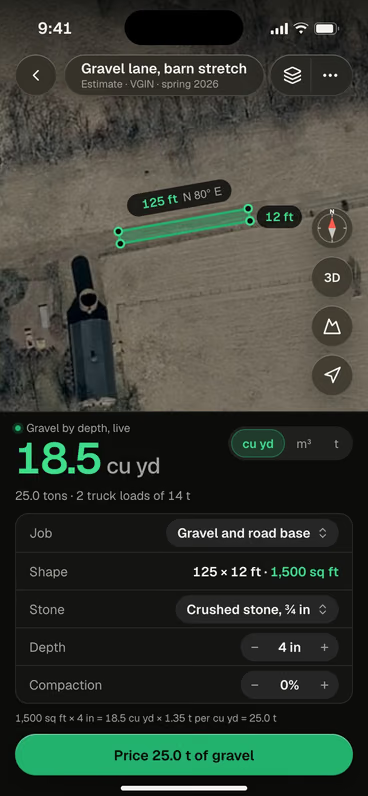
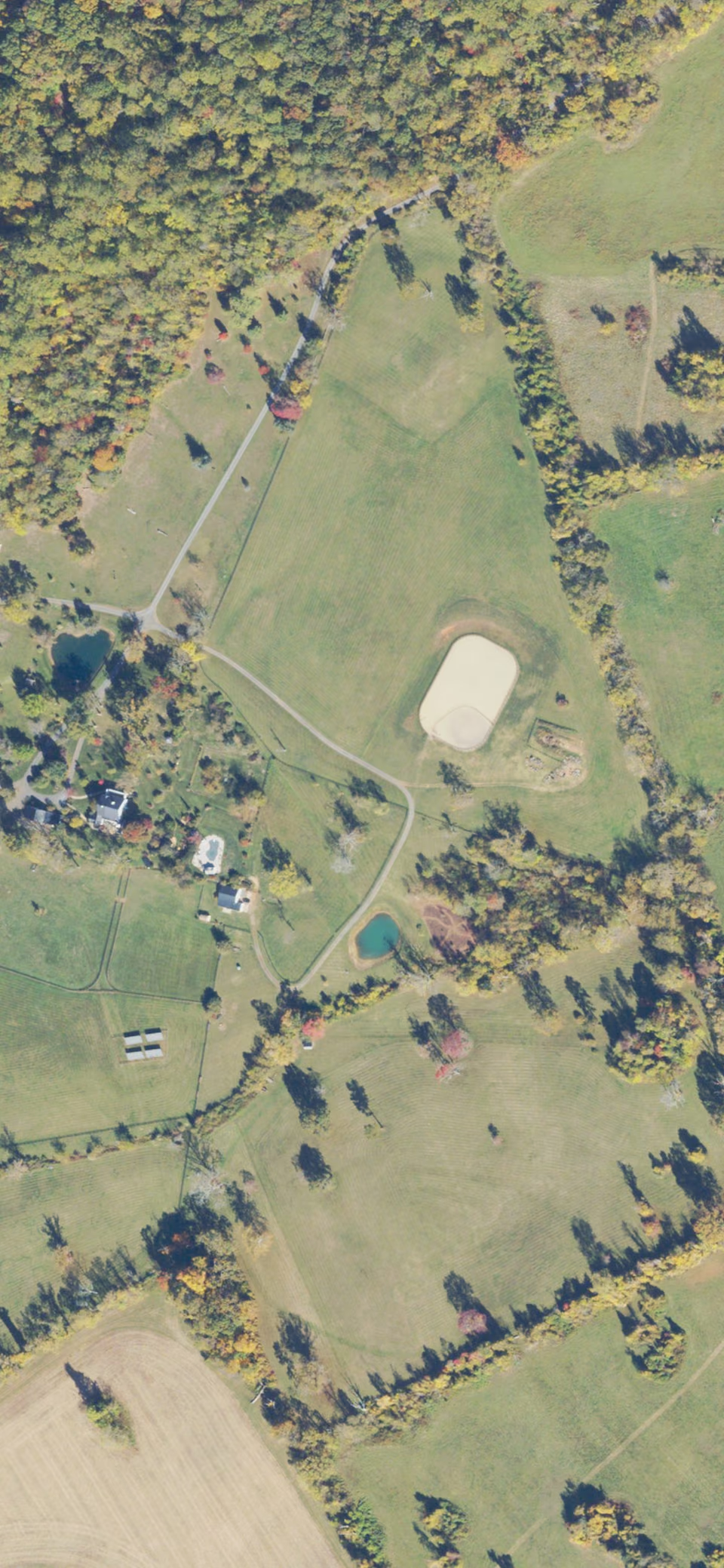
Outline the drive, set the depth of a layer, and the volume reads in cubic yards: 1,500 sq ft at 4 in is 18.5 cu yd.
The gravel calculator does the same sum for any shape and depth, in cubic yards and tons.
How do you prepare the ground for a gravel driveway?
You prepare the ground by removing sod, topsoil and roots down to firm subsoil, shaping the crown, and compacting the soil before any stone goes on. Topsoil left under the stone stays soft and lets ruts form.
- Mark it out. Stake both edges and run string lines. Call 811 before you dig.
- Dig out. Remove the soft soil, about 8 to 12 in, the depth of the stone you will put back.
- Shape and compact. Rake the ground to the crown and compact it. Fill soft spots and compact again.
- Lay fabric. Roll woven geotextile along the drive, overlap the joins by a foot or so, and pin it.
How do you lay and compact each gravel layer?
You lay each gravel layer by spreading it evenly to its depth, raking it to the crown, and compacting it before the next layer goes on. A plate compactor works for a short drive; a ride-on roller is quicker for a long lane. Wet the stone lightly if it is dusty, since damp stone compacts tighter.
Spread the base from the truck in short dumps or with a tractor, not in one heap. Check the depth as you go with a stake marked at the layer’s thickness. The top layer of crusher run has the fines that bind it; compact it until a footprint barely shows.
How do you install landscape rock?
You install landscape rock by digging out 2 to 3 in of soil, laying landscape fabric, setting an edge, and spreading the rock 2 to 3 in deep. It is the same method as a driveway with one layer and no load: the fabric stops weeds and keeps the rock out of the soil, and the edge keeps it in the bed.
- Outline the bed and dig out the sod and soil to the rock’s depth, so the rock sits level with the lawn.
- Set the edging of steel, aluminum, plastic or stone along the outline.
- Lay fabric over the soil, overlap the joins and pin it. Cut an X for each plant.
- Spread the rock 2 to 3 in deep and rake it level.
For a 200 sq ft bed at 3 in, that is 200 × 3 ÷ 12 ÷ 27 = 1.85 cu yd, about 2.6 tons. The landscape rock calculator works it out for your bed.
 Measure the drive, get the yardsOutline the drive or bed in AreaPal, set each layer's depth and price the stone, delivery and labor.

How do you keep gravel in place?
You keep gravel in place with an edge along both sides and a well-compacted crown that sheds water instead of washing stone away. Timber, steel or concrete edging works on a drive; a compacted shoulder of soil and grass works on a farm lane. Rake stone back from the edges after heavy rain, and top up the surface with crusher run every few years.
What does a gravel driveway cost?
A gravel driveway costs $1 to $3 per square foot installed according to LawnStarter (2026), and $6 to $18 per square foot with labor according to Fixr (2025). The two sources differ widely, so measure the drive and get local quotes for that area. These are what a contractor charges the customer, not AreaPal’s price.
| Job | Typical cost | Source |
|---|---|---|
| gravel (average)Material; delivery not stated | $30–$100 per ton | LawnStarter, October 2026 |
| gravel driveway installedInstalled, materials and labor | $1–$3 per sq ft | LawnStarter, October 2026 |
| gravel driveway, labor-inclusivePaving a gravel driveway, labor included | $6–$18 per sq ft | Fixr, August 2025 |
What a contractor charges the customer. US, read November 2026. Not AreaPal's price.
For the stone alone, LawnStarter gives $30 to $100 per ton (2026, delivery not stated). Multiply the tons from your own layers by that range for the stone, then add delivery. For prices by stone type and by the cubic yard, see how much gravel and landscape rock cost.
Questions
How do you lay landscape rock on a slope?
Use angular crushed stone rather than round river rock, since angular stone locks together and rolls less. Pin the fabric well, use bigger stone on steeper ground, and on a steep bank build low steps or terraces so the rock has something to sit against.
How do you make a crushed stone walkway or patio?
Dig out a few inches, lay fabric, then compact a few inches of coarse crushed stone and finish with 1 to 2 in of fine crushed stone or stone dust, compacted. Edge it so the stone stays in the path.
Do you need fabric under gravel?
On soft or clay soil, yes: woven geotextile keeps the stone from sinking into the mud and the soil from rising into the stone. On firm, well-drained ground, a well-compacted base can do without it.
How much area does a ton of gravel cover?
About 77 sq ft at 3 in deep, at 1.4 tons per cubic yard. At 2 in a ton covers about 116 sq ft, and at 4 in about 58 sq ft.
Sources: Stone sizes #3 and #57: AASHTO M 43. Layer depths (about 8 to 12 in in all) and crusher run on top: common driveway practice in aggregate suppliers' guidance. Crown of about ½ in per foot (4%): FHWA and South Dakota LTAP, Gravel Roads Construction and Maintenance Guide. 1 cu yd = 27 cu ft: NIST Handbook 44. Weight: 1.4 tons per cubic yard is an assumption; supplier tables give about 1.3 for pea gravel to 1.6 for crushed stone. Call 811: Common Ground Alliance. Typical costs, what the customer pays (US): LawnStarter, gravel driveway price (October 5, 2026); Fixr, Cost to Pave a Driveway (August 29, 2025). The 125 × 12 ft lane is AreaPal's example measurement.
 Imagery USDA NAIP 2023
