Hardscape estimating software.
Pavers, base and walls, counted.
Hardscape estimating software turns square feet into pavers, base and sand: pavers per square foot plus 5 to 15% for the pattern, 4 to 6 in of compacted base and 1 in of sand. A 12 × 16 ft (17.8 m²) herringbone patio takes 951 pavers (4 × 8 in), 5.7 t of base and 0.6 cu yd of sand.
By the AreaPal team · Updated
- Or pallets (110 sq ft)
- 2 pallets
- Gravel base, 6 in compacted
- 6 tons
- Bedding sand, 1 in
- 1 yd³
- Polymeric sand, 50 lb
- 4 bags
- Edge restraint, 8 ft pieces
- 7 pieces
- Area
- 192 sq ft
Pattern waste 5–15%, base compaction 20%. Same math as the AreaPal app's paver estimate.
From the hardscape job to a signed quote.
Search the address and draw the line, the lawn, the drive or the roof on the satellite map.
Materials with waste, labor, markup and tax, from your own price book.
Up to three options with your logo. Send the link from your own phone.
Your customer picks an option and signs with a finger. No app, no account.
Hardscape estimates, step by step.
Example: a 12 × 16 ft paver patio, 90° herringbone
951 pavers, 4 × 8 in. Here is what the estimate counts, line by line. Open the paver calculator to change the numbers.
| Item | Note | Qty |
|---|---|---|
| Pavers, 4 × 8 in | 4.5 per sq ft + 10% pattern waste | 951 |
| Base, crushed stone | 6 in compacted, +15% | 5.7 t |
| Bedding sand | 1 in | 0.6 cu yd |
| Edge restraint | around the patio | 56 ft |
| Dig out | 9⅜ in deep | 5.6 cu yd |
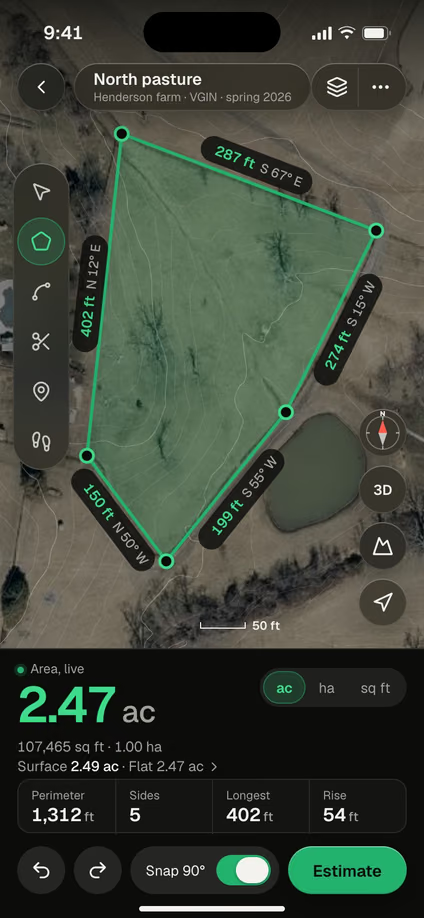
Don’t know the length or the area? Measure it on the satellite map in AreaPal.
How many pavers do I need?
The pavers you need are the area in square feet × pavers per square foot, plus the pattern’s waste: 4 × 8 in pavers run 4.5 per sq ft, so 192 sq ft in herringbone takes 951.
Sizes here are nominal. Most pavers are a little smaller than their name, so use the maker’s count per square foot when the pallet lists one.
| Paver size | Per sq ft | For 100 sq ft + 10% |
|---|---|---|
| 4 × 8 in | 4.5 | 495 |
| 6 × 6 in | 4 | 440 |
| 6 × 9 in | 2.67 | 294 |
| 12 × 12 in | 1 | 110 |
| 16 × 16 in | 0.56 | 62 |
| 12 × 24 in | 0.5 | 55 |
How much waste do paver patterns need?
Paver patterns need about 5% extra for straight layouts and 10 to 15% for herringbone, diagonals and curves, because every cut at the edge wastes part of a paver.
| Pattern | Add |
|---|---|
| Running bond or stack bond | 5% |
| Basketweave | 5% |
| 90° herringbone | 10% |
| 45° herringbone or diagonal | 15% |
| Circles and curves | 15% or more |
How deep should paver base be?
Paver base should be 4 to 6 in of compacted crushed stone for patios and walks and 8 to 12 in for driveways, under 1 in of bedding sand, with the deeper figure on clay or where the ground freezes.
Dig out the base, the sand and the paver together: 6 in of base, 1 in of sand and a 2⅜ in paver is a 9⅜ in dig. The table uses 2⅜ in pavers for patios and 3⅛ in for drives, and its base tonnage includes 15% for compaction.
| Job | Base | Base per 100 sq ft | Dig out |
|---|---|---|---|
| Patio or walk | 4 in | 2.0 t | 7⅜ in |
| Patio or walk, clay or frost | 6 in | 3.0 t | 9⅜ in |
| Driveway | 8 in | 4.0 t | 12⅛ in |
| Driveway, clay or frost | 12 in | 6.0 t | 16⅛ in |
How many tons is a yard of gravel?
A cubic yard of gravel or crushed stone weighs about 1.4 tons (2,800 lb), so tons ≈ cubic yards × 1.4; one ton spread 3 in deep covers about 77 sq ft.
Stone type changes the weight, from about 1.3 to 1.5 t per cubic yard, so check the supplier’s ticket. For a crushed stone driveway, figure each layer on its own and add 10 to 15% for compaction.
| Depth | Cu yd per 100 sq ft | Tons per 100 sq ft | Sq ft per ton |
|---|---|---|---|
| 2 in | 0.62 | 0.86 | 116 |
| 3 in | 0.93 | 1.30 | 77 |
| 4 in | 1.23 | 1.73 | 58 |
| 6 in | 1.85 | 2.59 | 39 |
How many retaining wall blocks do I need?
Retaining wall blocks = blocks per course × courses, with the courses rounded up and one more buried below grade. A 40 ft wall 3 ft high in 6 × 16 in blocks takes 210.
Add caps for the wall’s length and about 12 in of drain stone behind it for the full height. Follow the block maker’s guide for how deep to bury the first course and when a wall needs geogrid.
| Block face | Per sq ft of face | Courses | Blocks |
|---|---|---|---|
| 4 × 12 in | 3 | 9 + 1 | 400 |
| 6 × 16 in | 1.5 | 6 + 1 | 210 |
| 8 × 16 in | 1.13 | 5 + 1 | 180 |
| 8 × 18 in | 1 | 5 + 1 | 162 |
How much does hardscaping cost per square foot?
A paver patio costs the customer $10 to $24 per square foot installed (LawnStarter, 2026); This Old House (2026) gives $8 to $25 per square foot installed.
| Job | Typical cost | Source |
|---|---|---|
| paver patio installedInstalled, labor and materials | $10–$24 per sq ft | LawnStarter, November 2026 |
| paver patio installedInstalled | $8–$25 per sq ft | This Old House, June 2026 |
| retaining wallAverage $33 per sq ft; interlocking block $15–$35, poured concrete $20–$40 | $20–$53 per sq ft | LawnStarter, October 2026 |
| retaining wall, backyardBackyard walls; slope ($40–$200) and shoreline ($108–$288 per linear ft) walls cost more | $33–$255 per linear foot | LawnStarter, October 2026 |
| retaining wall installedInstalled, materials and labor; segmental block $15–$35, concrete block $30–$50 per sq ft of face | $15–$45 per sq ft of face | Fixr, January 2025 |
| retaining wallBackyard $30–$150, slope $40–$200, shoreline $150–$600 per linear ft | $20–$600 per linear foot | Fixr, January 2025 |
| gravel driveway installedInstalled, materials and labor | $1–$3 per sq ft | LawnStarter, October 2026 |
| gravel driveway, labor-inclusivePaving a gravel driveway, labor included | $6–$18 per sq ft | Fixr, August 2025 |
What a contractor charges the customer. US, read November 2026. Not AreaPal's price.
Sources: ICPI (Interlocking Concrete Pavement Institute) Tech Spec 2 for base and bedding sand depths; pattern waste as typical installer allowances; aggregate suppliers’ published weights (about 1.3 to 1.5 t per cu yd); block makers’ installation guides (Allan Block, Versa-Lok) for buried courses and drain stone. Typical installed costs, what a contractor charges the customer: LawnStarter paver patio (November 2026), retaining wall and gravel driveway (October 2026) cost guides; This Old House paver patio (June 2026); Fixr retaining wall (January 2025) and driveway paving (August 2025) cost guides.
Pavers, walls and stone. Each one counted with its base.
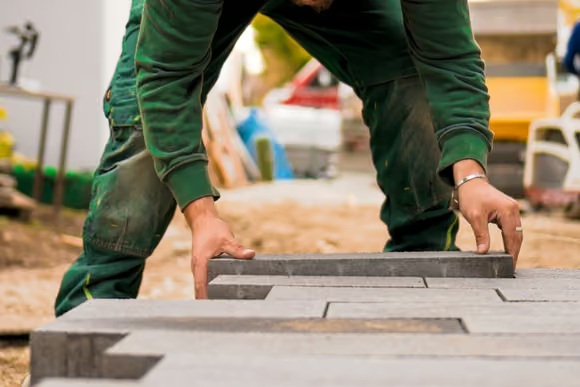
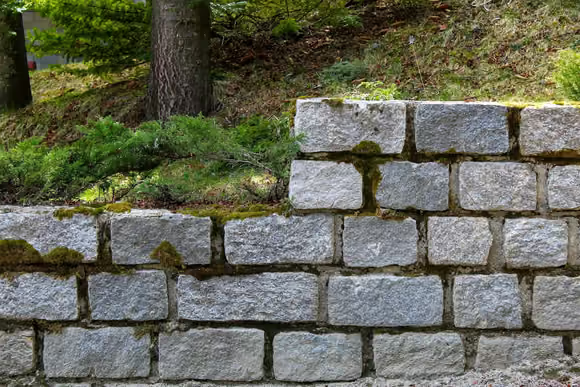
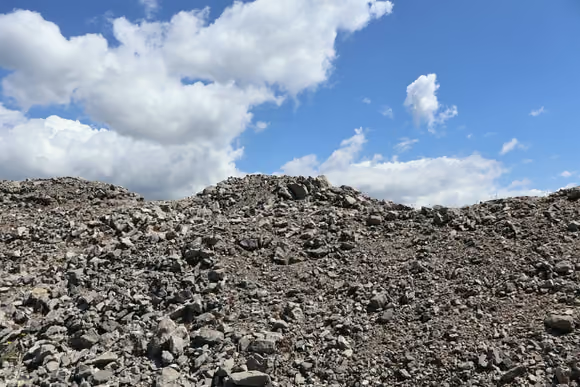
Photos by FRAEM GmbH, Zhivko Minkov, Laura Roberts, Giorgos Giannatos on Unsplash.
Every quote, tracked to a yes.
Quotes with their status, options your customer can compare, and every client with their areas.
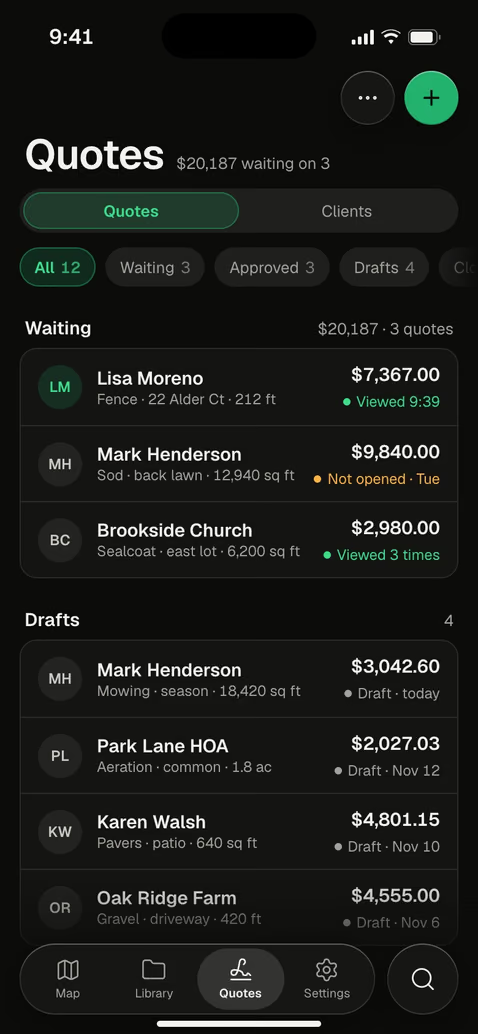
Sent, viewed, approved, declined or expired, with a push when a customer opens one.
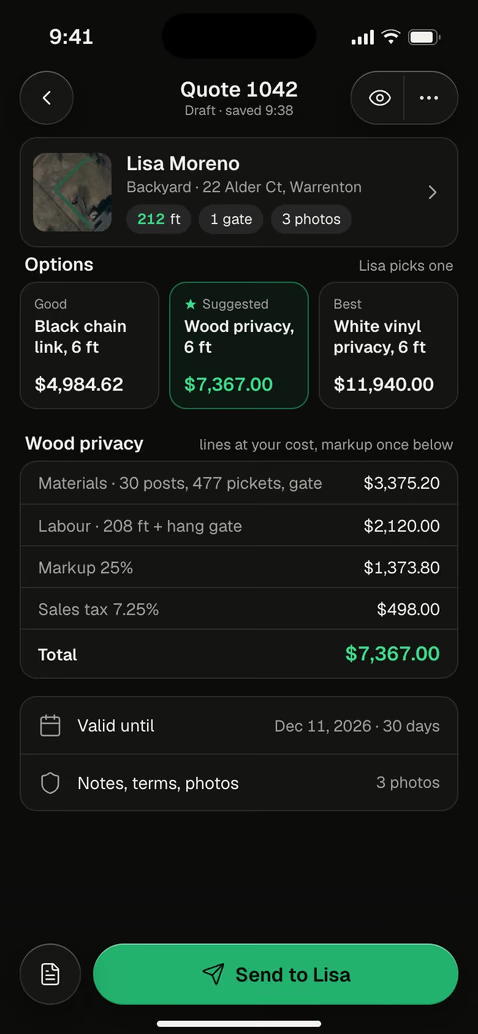
Up to three options on one quote, with your logo, terms and a valid-until date.
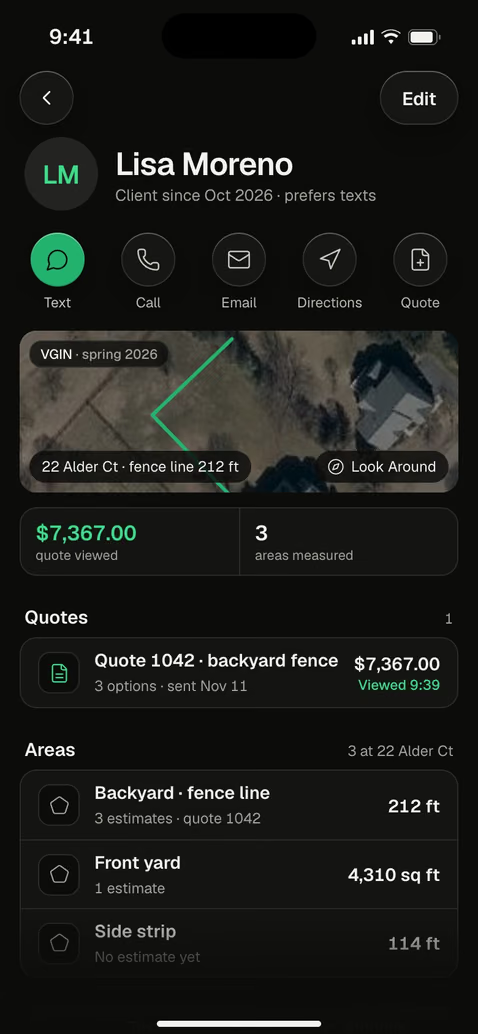
Every customer with the areas you measured and the quotes they have had.
Hardscape questions, answered.
How do you write a paver patio quote?
Measure the patio, count pavers with pattern waste, base, sand and edging, then add labor by the square foot, delivery, markup and tax. In AreaPal the quote can carry up to three options, such as two paver styles and a concrete patio.
Is there a paver or gravel calculator app that quotes the job?
AreaPal measures the patio, drive or wall line on the satellite map, works out pavers, base, sand, blocks and tons of gravel from your price book, and sends a quote your customer signs in the browser.
How much gravel do I need for a driveway?
Multiply length × width × depth in feet, divide by 27 for cubic yards, then multiply by about 1.4 for tons. A 12 × 50 ft drive 4 in deep is 7.4 cu yd, about 10.4 t before compaction.
Can I measure a patio or drive on a satellite map?
Yes, when the edges are visible from above. Draw the area in AreaPal, cut out anything that stays, such as a planter or a pool, and the net square footage feeds the estimate.
Measure the patio.
Quote it before you leave.