
The short answer
- Base: 4 to 6 in of compacted crushed stone for a patio or walk, 8 to 12 in for a driveway.
- Bedding: 1 in of coarse concrete sand, screeded flat and not compacted before the pavers go down.
- Order 5 to 10% extra pavers for cuts, and more for 45° herringbone and curves.
- Slope the surface about ⅛ to ¼ in per foot away from the house so water drains.
How do you lay pavers?
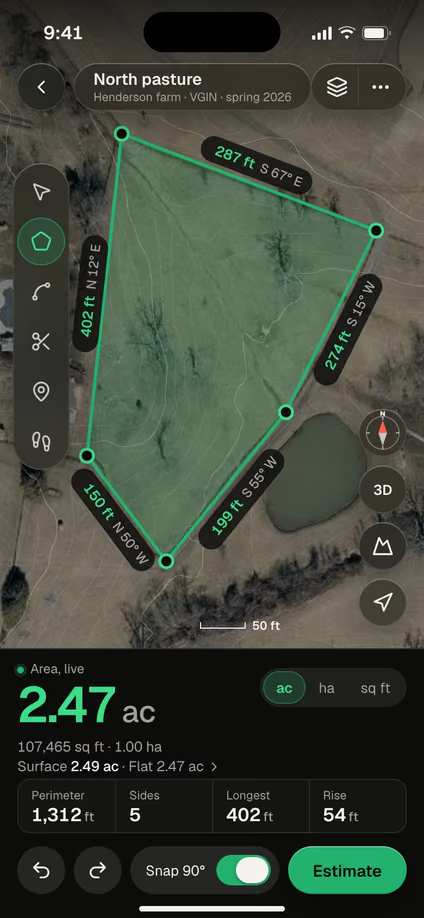
You lay pavers by building a compacted crushed stone base, screeding a 1 in bed of sand on it, setting the pavers in a pattern, cutting the edges, fixing edge restraint and sweeping sand into the joints. The base does the real work; a patio that sinks or ripples almost always had too little base or base that was never compacted.
| Layer | Material | Depth |
|---|---|---|
| Subgrade | Undisturbed or compacted soil | Graded to the slope |
| Base | Crushed stone with fines (dense-graded aggregate) | 4–6 in patio, 8–12 in driveway |
| Bedding | Coarse concrete sand, screeded, not compacted | 1 in |
| Pavers | Concrete or clay pavers | 2⅜ in patio, 3⅛ in driveway |
| Joints | Joint sand or polymeric sand | Filled to the top |
How deep should the base for pavers be?
The base for pavers should be 4 to 6 in of compacted crushed stone for a patio or walk, and 8 to 12 in for a driveway, with the deeper figure on clay or where the ground freezes. Dig out the base, the sand and the paver together: 6 in of base, 1 in of sand and a 2⅜ in paver is a 9⅜ in dig.
Spread the base in layers of a few inches and compact each one with a plate compactor before adding the next; one thick layer compacts only at the top. Grade the base to the final slope, about ⅛ to ¼ in per foot away from the house, so the sand and pavers can go on at an even thickness. Over a 12 ft patio that is a fall of 1½ to 3 in.
How much base, sand and pavers do you need?
You need the patio’s area × the base depth ÷ 27 for cubic yards of base, the area ÷ 324 for cubic yards of 1 in sand, and the area × pavers per square foot plus the pattern’s waste. Here is a 12 × 16 ft patio, 192 sq ft (17.8 m²), in 4 × 8 in pavers laid in 90° herringbone:
| Item | Calculation | Amount |
|---|---|---|
| Pavers, 4 × 8 in | 192 sq ft × 4.5 = 864, + 10% herringbone | 951 |
| Base, 6 in compacted | 192 × 6 ÷ 12 ÷ 27 = 3.56 cu yd, + 15% compaction, × 1.4 t | 5.7 tons |
| Base, 4 in compacted | 192 × 4 ÷ 12 ÷ 27 = 2.37 cu yd, + 15%, × 1.4 t | 3.8 tons |
| Bedding sand, 1 in | 192 ÷ 324 | 0.6 cu yd |
| Edge restraint | 2 × (12 + 16) | 56 ft |
| Dig out, 6 in base | 192 × 9⅜ ÷ 12 ÷ 27 | 5.6 cu yd |
The paver calculator counts pavers and base for any size and pattern, and the sand calculator works out the bedding and joint sand.
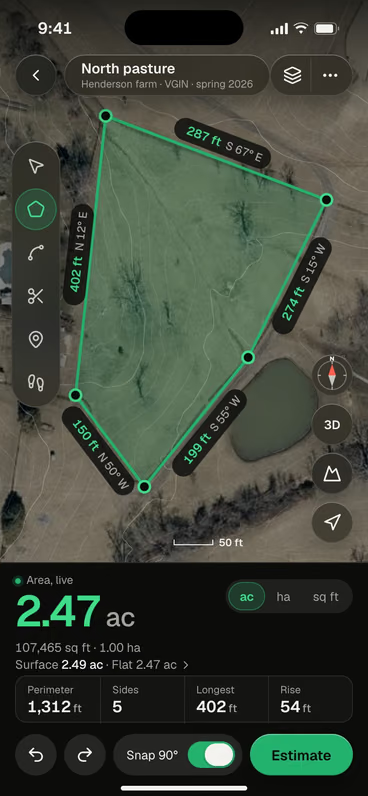
Outline the patio or drive on the satellite map, cut out anything that stays, such as a planter, and the net square feet and the edge length are the numbers the materials come from.
How do you screed the sand for pavers?
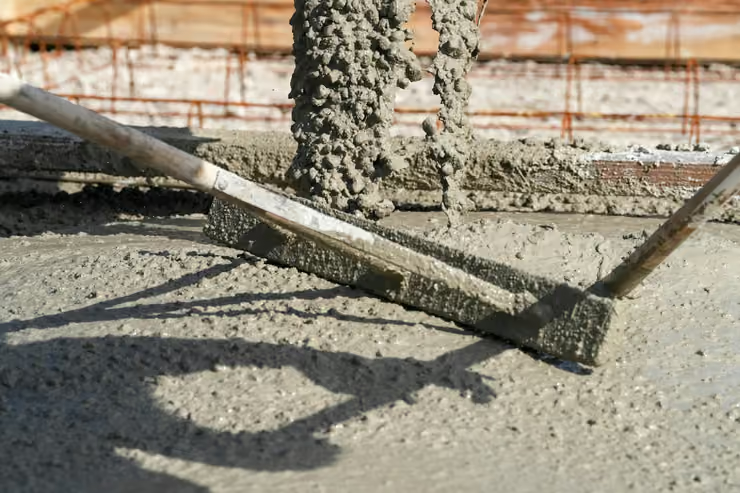
You screed the sand by laying two straight pipes 1 in thick on the base as rails, filling between them with coarse concrete sand, and dragging a straight board across the pipes to leave a flat bed exactly 1 in deep. Lift the pipes out, fill their grooves with sand and smooth them with a trowel.
Screed only as much as you will cover that day, and keep off it: every footprint is a low spot under a paver. The sand is not compacted now; the pavers settle into it when the finished surface is compacted.
Which paver pattern should you choose, and how much waste does it need?
You choose a paver pattern for the look and for the load: running bond and basketweave are simplest and waste least, while herringbone interlocks best and is the pattern for driveways. Order extra for the cuts at the edges, about 5% for straight layouts and 10 to 15% for herringbone, diagonals and curves.
| Pattern | Order extra | Notes |
|---|---|---|
| Running bond | 5% | Straight rows, easiest to lay |
| Basketweave | 5% | Pairs at right angles, patios and walks |
| 90° herringbone | 10% | Interlocks well, good for drives |
| 45° herringbone or diagonal | 15% | More cuts at every edge |
| Circles and curves | 15% or more | Cuts along the whole curve |
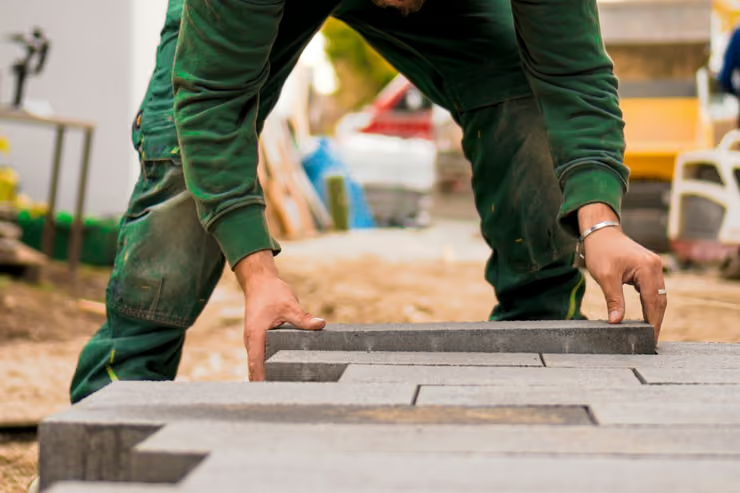
Lay from a straight edge or a corner, setting each paver straight down into the sand rather than sliding it, so sand doesn’t build up in the joints. Pull pavers from several pallets as you go to blend the color, and check the lines with a string every few rows.
How do you finish the edges and the joints?
You finish the edges by cutting pavers to fit and fastening edge restraint tight against them, then you finish the joints by compacting the pavers and sweeping sand into the gaps until they are full. Without edge restraint, pavers creep apart at the edges within a season.
- Cut the edge pavers with a paver splitter or a wet saw. Avoid slivers: a cut piece should be at least a third of a paver.
- Fix the restraint of plastic, aluminum, steel or a concrete haunch along every open edge, spiked or set so it can’t move.
- Compact with a plate compactor, working from the edges in, so the pavers press into the sand.
- Fill the joints. Sweep joint sand or polymeric sand into the gaps, compact again, and repeat until the joints stay full.
 Measure the patio, count the paversOutline it in AreaPal, pick the pattern and quote the pavers, base, sand and labor.

How do you lay block paving on a driveway?
You lay block paving on a driveway the same way as a patio, with a deeper base of 8 to 12 in, thicker pavers of about 3⅛ in (80 mm), and a herringbone pattern that locks under turning wheels. Block paving is the British name for interlocking pavers.
Compact the base in more layers than for a patio, since a car puts far more load on it than feet do, and make sure the drive falls toward a drain or the street, never toward the garage. A drive of 8 in base, 1 in sand and a 3⅛ in paver is a 12⅛ in dig.
Can you lay pavers on a concrete slab?
You can lay pavers on a concrete slab if the slab is sound, uncracked and already sloped to drain, either on a thin bed of sand or bonded with mortar. Leave a way for water to get out at the low edge, and use thin pavers so the new surface doesn’t rise above a door threshold. A cracked or heaving slab should come out first, since the pavers will follow the cracks.
What does a paver patio cost?
A paver patio costs $10 to $24 per square foot installed according to LawnStarter (2026), and $8 to $25 according to This Old House (2026). That is what a contractor charges the customer, not AreaPal’s price.
| Job | Typical cost | Source |
|---|---|---|
| paver patio installedInstalled, labor and materials | $10–$24 per sq ft | LawnStarter, November 2026 |
| paver patio installedInstalled | $8–$25 per sq ft | This Old House, June 2026 |
What a contractor charges the customer. US, read November 2026. Not AreaPal's price.
For what drives the price and how to estimate your own patio, see how much a paver patio costs. Hardscape installers can see how AreaPal counts pavers, base and sand and turns them into a quote on the hardscape contractors page.
Questions
What sand do you put under pavers?
Coarse, washed concrete sand, 1 in thick. Fine mason sand and stone dust hold water and let pavers move, so the industry guidance from ICPI is to avoid them for the bedding layer.
Do you compact the sand before laying pavers?
No. Screed the sand flat and leave it loose; the pavers are pressed into it when you run the plate compactor over them afterward. Smooth any footprints before you lay over them.
Should you use polymeric sand in paver joints?
Polymeric sand hardens when wetted and resists weeds and washout better than plain joint sand. It must go in dry and be swept off the paver faces before you wet it, or it leaves a haze. Follow the bag's directions.
How do you lay block paving edging?
Set edge restraint of plastic, aluminum, steel or a concrete haunch on the compacted base, tight against the outer pavers, and spike or set it so it can't move. Without it the pavers creep apart at the edges.
How many pavers do I need?
Multiply the area in square feet by the pavers per square foot, then add the pattern's waste. 4 × 8 in pavers run 4.5 per sq ft, so a 192 sq ft patio in 90° herringbone takes 864 + 10% = 951.
Sources: Base and bedding sand depths, coarse concrete sand for bedding, paver thickness and herringbone for driveways: ICPI (Interlocking Concrete Pavement Institute) Tech Spec 2. Slope of ⅛ to ¼ in per foot: common patio drainage practice. Pattern waste allowances: typical installer practice. Weight: 1.4 tons per cubic yard of crushed stone is an assumption; supplier tables give about 1.3 to 1.6. Call 811: Common Ground Alliance. Typical installed costs, what a contractor charges the customer (US): This Old House, paver patio cost (June 10, 2026); LawnStarter, paver patio cost (November 3, 2026). Read November 2026.
 Imagery USDA NAIP 2023
