Retaining wall calculator
A wall of 6 × 16 in blocks takes 0.75 blocks per foot per course, with one course buried below grade and 3% extra. A 48 ft wall 3 ft high is 7 courses of 36: 260 blocks, 38 caps and 9 tons of drain stone.
Updated · Same math as the AreaPal app's estimates
How many retaining wall blocks do I need?
260blocks
38caps
7courses
$2,880–$7,632
Retaining wall, $20–$53 per sq ft, from LawnStarter, October 2026- Drain stone
- 9 tons
- Base pad gravel
- 3 tons
- Geogrid, 50 ft rolls
- 2 rolls
- Drain pipe, 10 ft
- 5 pieces
6 × 16 in blocks, one buried course, 3% waste. Same math as the AreaPal app's retaining wall estimate.
Step 2 · the real size
Measure the real job in AreaPal
A typed rectangle is a guess. Draw the outline on the satellite map and the estimate uses the exact area, with the same math as this calculator.
Draw it on the map
Tap the corners on the satellite view, or walk the edge with GPS.
Satellite map or GPS walkGet the exact area
Square feet, acres and every edge length, as you tap.
Cut-outs taken offCount it and quote it
The estimate counts the materials; the quote prices them with your own costs.
Same math as this page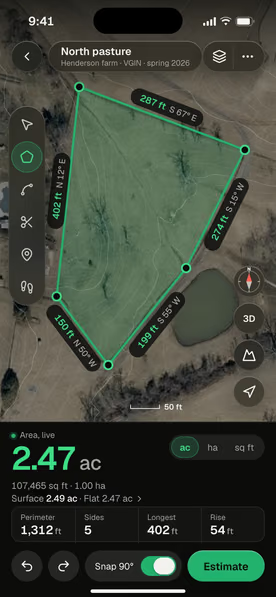

How do you calculate a retaining wall?
Courses = height × 12 ÷ block height, rounded up, plus one buried course. Blocks per course = length × 12 ÷ block length. Blocks = per course × courses × 1.03. Drain stone: 12 in behind the wall for its full height. Base pad: 24 × 6 in of compacted gravel. Walls 3 ft and higher get geogrid every other course above the third.
How many blocks for each wall size?
| Wall | Courses | Blocks | Caps |
|---|---|---|---|
| 20 × 2 ft | 5 | 78 | 16 |
| 30 × 3 ft | 7 | 166 | 24 |
| 48 × 3 ft | 7 | 260 | 38 |
| 60 × 4 ft | 9 | 418 | 47 |
Retaining wall job cost: what contractors charge
Ranges from public cost guides, as each one states them. They're what a contractor charges for the work, not material prices and not AreaPal's. A real quote starts with measuring the job.
| Job | Typical cost | Source |
|---|---|---|
| Retaining wallAverage $33 per sq ft; interlocking block $15–$35, poured concrete $20–$40 | $20–$53 per sq ft | LawnStarter, October 2026 |
| Retaining wall, backyardBackyard walls; slope ($40–$200) and shoreline ($108–$288 per linear ft) walls cost more | $33–$255 per linear foot | LawnStarter, October 2026 |
| Retaining wall installedInstalled, materials and labor; segmental block $15–$35, concrete block $30–$50 per sq ft of face | $15–$45 per sq ft of face | Fixr, January 2025 |
| Retaining wallBackyard $30–$150, slope $40–$200, shoreline $150–$600 per linear ft | $20–$600 per linear foot | Fixr, January 2025 |
Work out the rest of the job
Retaining walls, answered
How deep should a retaining wall be buried?
One course, or about 10% of the wall's height, below grade, on a compacted gravel pad about 6 in thick.
When does a retaining wall need geogrid?
Most block makers call for geogrid from about 3 ft, and many towns require an engineer above 4 ft. Follow the block's installation guide.
How much gravel behind a retaining wall?
A 12 in band of clean drain stone for the full height, with a perforated drain pipe at the bottom.
Sources: 6 × 16 in block face, one buried course, 3% waste, a 12 in drain zone and a 24 × 6 in compacted pad, geogrid from 3 ft: AreaPal app rules. Follow your block maker's installation guide.
Measure the real area first.
Then count the materials.
Draw the slab, bed, drive or fence line on the satellite map in AreaPal, and the estimate uses the same math as this calculator.
 Imagery USDA NAIP 2023
