Estimates for your line striping business.
Stalls, paint and stencils, then the quote.
A line striping business estimates a lot by the stall: each 9 ft stall at 90° adds an 18 ft line, and a gallon of traffic paint lays about 320 ft of 4 in line (97.5 m at 10 cm). A 100-stall lot with 220 ft of fire lane is 2,020 ft of line, 7 gallons, plus stencils.
By the AreaPal team · Updated
- 5 gallon pails
- 6 pails
- Or 55 gallon drums
- 1 drums
- Area
- 1,200 sq ft
90 sq ft per gallon per coat. Same math as the AreaPal app's sealcoat estimate.
From the line striping job to a signed quote.
Search the address and draw the line, the lawn, the drive or the roof on the satellite map.
Materials with waste, labor, markup and tax, from your own price book.
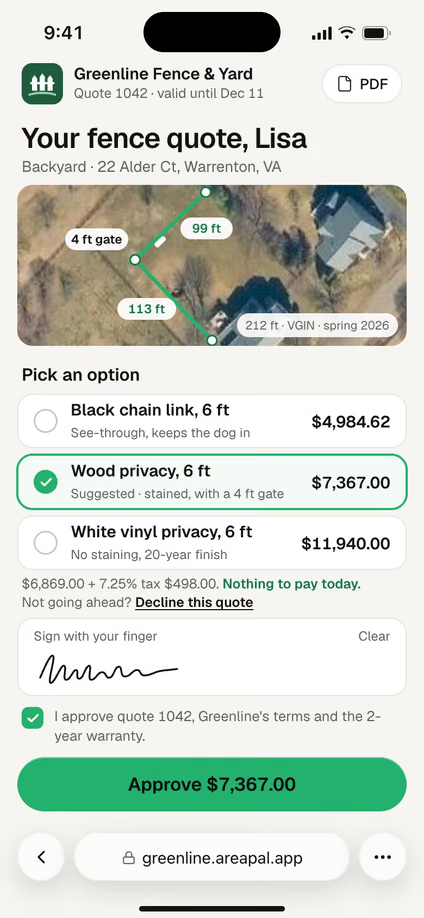
Up to three options with your logo. Send the link from your own phone.
Your customer picks an option and signs with a finger. No app, no account.
Line striping estimates, step by step.
Example: 100 stalls with 4 accessible, 4 arrows and 220 ft of fire lane
2,020 ft of line. Here is what the estimate counts, line by line. Sealing the lot first? Sealcoating calculator to change the numbers.
| Item | Note | Qty |
|---|---|---|
| Stall lines | 100 × 18 ft | 1,800 ft |
| Fire lane | painted by the foot | 220 ft |
| Traffic paint | 4 in line, about 320 ft a gallon | 7 gal |
| Stencils | 4 accessible symbols, 4 arrows | 8 |
Don’t know the length or the area? Measure it on the satellite map in AreaPal.
How many feet of line per parking stall?
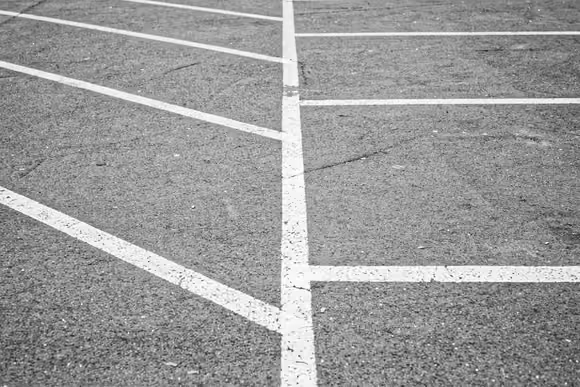
Each standard parking stall adds one line about 18 ft long, so a row of n stalls has n + 1 lines; a row of 10 stalls at 90° is 11 lines, 198 ft.
Angled stalls take more curb: a 9 ft stall at 45° uses 12.73 ft along the row, so fewer stalls fit. Measure each row as a line and divide by the curb length per stall.
| Stall angle | Along the row per stall | Stalls per 100 ft of row |
|---|---|---|
| 90° | 9.00 ft (2.74 m) | 11 |
| 60° | 10.39 ft (3.17 m) | 9 |
| 45° | 12.73 ft (3.88 m) | 7 |
How much paint does it take to stripe a parking lot?
A gallon of traffic paint covers about 320 linear ft of 4 in line at 15 mils wet, or about 214 ft of 6 in line, so gallons = feet of line ÷ 320.
That is a gallon's 231 cu in spread 4 in wide and 0.015 in thick. Rough or porous asphalt takes more; a second coat doubles it.
| Lot | Feet of line | Gallons |
|---|---|---|
| One row of 10 stalls | 198 ft | 0.6 → 1 |
| 50 stalls | 900 ft | 2.8 → 3 |
| 100 stalls and 220 ft of fire lane | 2,020 ft | 6.3 → 7 |
| 200 stalls | 3,600 ft | 11.3 → 12 |
How many accessible parking stalls does a lot need?
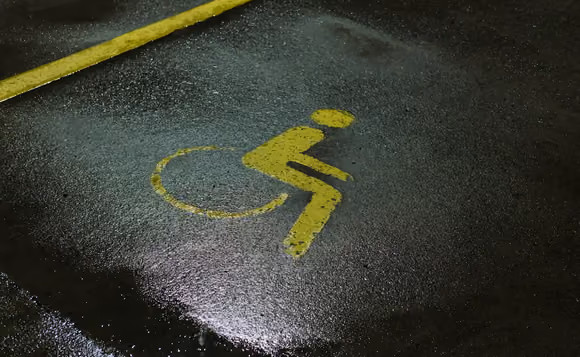
The 2010 ADA Standards set the number of accessible stalls by the lot's total: 1 for up to 25 stalls, 4 for 76 to 100, 5 for 101 to 150, and at least 1 in 6 must be van accessible.
A car stall is 96 in (2.44 m) wide with a 60 in (1.52 m) access aisle; a van stall is 132 in wide with a 60 in aisle, or 96 in with a 96 in aisle.
| Total stalls | Accessible stalls |
|---|---|
| 1–25 | 1 |
| 26–50 | 2 |
| 51–75 | 3 |
| 76–100 | 4 |
| 101–150 | 5 |
| 151–200 | 6 |
| 201–300 | 7 |
| 301–400 | 8 |
| 401–500 | 9 |
| 501–1,000 | 2 % of the total |
| Over 1,000 | 20, plus 1 for each 100 over 1,000 |
How do you price line striping?
Price line striping by the stall for standard layouts, by the linear foot for fire lanes, curbs and long lines, and by the piece for stencils and accessible symbols, plus a mobilization charge.
A new layout after paving or sealcoat takes measuring and chalk lines, so it is priced above a restripe that follows the old lines.
What does parking lot striping cost in 2026?
A standard 4 in parking lot line costs the customer $0.20 to $0.30 per linear foot (OneCrew, 2026).
| Job | Typical cost | Source |
|---|---|---|
| standard 4-inch line4 in line; re-striping a 25–50 space lot runs $400–$800 | $0.20–$0.30 per linear foot | OneCrew, January 2026 |
What a contractor charges the customer. US, read November 2026. Not AreaPal's price.
Sources: 2010 ADA Standards for Accessible Design §208.2 and §502 (accessible stall counts and sizes); NIST Handbook 44 (1 US gallon = 231 cu in) for paint coverage at 15 mils wet film; typical cost, what a contractor charges the customer: OneCrew parking lot striping bidding guide (January 2026).
Lots, floors and fire lanes. Each one counted its way.
Photos by Ingo Zöll, Ilker Ozmen, Mick Haupt, Hannes Egler on Unsplash.
Every quote, tracked to a yes.
Quotes with their status, options your customer can compare, and every client with their areas.
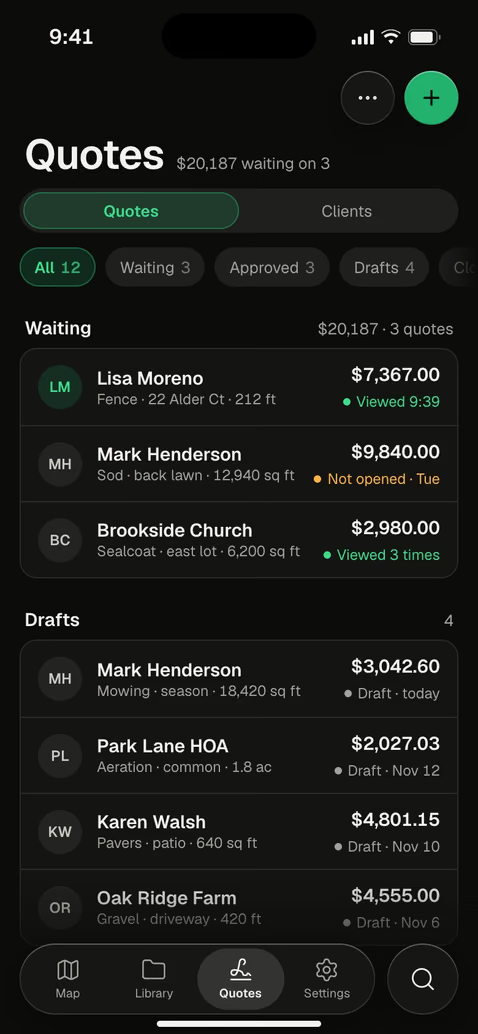
Sent, viewed, approved, declined or expired, with a push when a customer opens one.
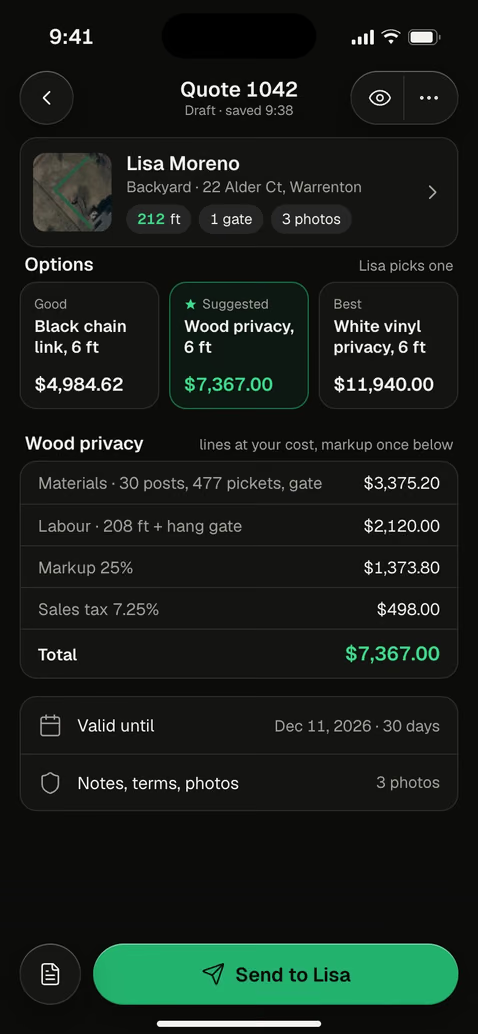
Up to three options on one quote, with your logo, terms and a valid-until date.
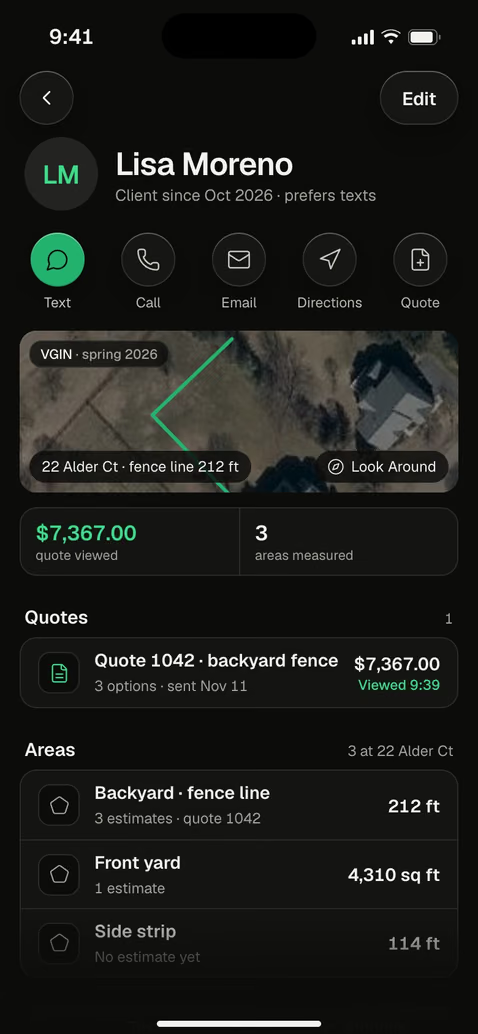
Every customer with the areas you measured and the quotes they have had.
Line striping questions, answered.
How do I start a line striping business?
Start with a walk-behind striper, traffic paint, stencils, insurance and the ADA rules for accessible stalls. Most first jobs are restripes after sealcoating, priced by the stall.
Can I count stalls from a satellite map?
Yes, when the lines are visible from above. In AreaPal you draw each row as a line and it counts the stalls from the stall width and angle, then prices the stalls, stencils and paint.
How wide is a parking stall?
Usually 8.5 to 9 ft wide and 18 ft deep, set by the local code. Accessible stalls are 8 ft wide with a 5 ft aisle under the ADA Standards.
How soon can a lot be striped after sealcoating?
Once the sealer has dried, often the same day or the next in warm weather. Follow the sealer's data sheet and keep traffic off the new lines until they dry.
Count the stalls.
Send the striping quote today.